

-
1 electrical copper
Большой англо-русский и русско-английский словарь > electrical copper
-
2 electrical copper
Англо-русский словарь технических терминов > electrical copper
-
3 electrical copper
Техника: электротехническая медь -
4 copper
1) медь, Cu || покрывать медью, омеднять || медный•-
1-oz copper
-
annealed copper
-
armature copper
-
bar copper
-
beryllium copper
-
Bessemer copper
-
blister copper
-
boronized copper
-
braziers' copper
-
brewing copper
-
cake copper
-
cap copper
-
casting copper
-
cast copper
-
chromium copper
-
dairy copper
-
dry copper
-
electrical copper
-
electrolytic copper
-
electrolytically refined copper
-
electrosheet copper
-
Everdur copper
-
field copper
-
fire-refined copper
-
flat copper
-
high-conductivity copper
-
ingot copper
-
liquated copper
-
mash copper
-
mass copper
-
native copper
-
overpoled copper
-
oxygen-free copper
-
pig copper
-
precipitated copper
-
pure copper
-
sheet copper
-
silicon copper
-
slab copper
-
soap copper
-
stamp copper
-
tough copper
-
tough-pitch copper
-
white copper
-
wort copper -
5 электротехническая медь
Большой англо-русский и русско-английский словарь > электротехническая медь
-
6 alloy
1) сплав || сплавлять2) легирующий элемент || легировать•- abrasion-resisting alloy
- acid-resistant alloy
- addition alloy
- age-hardening alloy
- aging alloy
- air-hardening alloy
- air-melted alloy
- alkali metal alloy
- alkaline earth alloy
- alkaline earth metal-aluminum alloy
- alkali-resistant alloy
- alkali-resisting alloy
- all-alpha alloy
- all-beta alloy
- alpha alloy
- alpha iron alloy
- alpha+beta alloy
- alpha-beta alloy
- alpha-phase alloy
- alpha-titanium alloy
- aluminum alloy of iron
- aluminum alloy
- aluminum casting alloy
- aluminum piston alloy
- aluminum-base alloy
- aluminum-bearing alloy
- aluminum-copper alloy
- aluminum-copper-magnesium alloy
- aluminum-copper-magnesium-nickel alloy
- aluminum-copper-silicon alloy
- aluminum-copper-silicon-magnesium alloy
- aluminum-magnesium alloy
- aluminum-magnesium-silicon alloy
- aluminum-manganese alloy
- aluminum-manganese-magnesium alloy
- aluminum-nickel-iron alloy
- aluminum-silicon alloy
- aluminum-zinc-silicon alloy
- anticorrosion alloy
- antifriction alloy
- as-cast alloy
- austenitic alloy
- barium-aluminum alloy
- bearing alloy
- beryllium alloy of iron
- beryllium-copper alloy
- beryllium-copper-aluminum alloy
- beta alloy
- beta-phase alloy
- beta-titanium alloy
- binary alloy
- bismuth alloy
- body-centered cubic alloy
- boron-bearing alloy
- brass brazing alloy
- brazing alloy
- cadmium alloy
- cadmium-nickel alloy
- cadmium-silver alloy
- carbide-strengthened alloy
- carbon-bearing alloy
- carbon-free alloy
- cast alloy
- castable alloy
- casting alloy
- chrome alloy
- chrome-base alloy
- chrome-bearing alloy
- chrome-nickel alloy
- chromium-nickel-tungsten alloy
- chromium-rich alloy
- chromium-tantalum alloy
- chromium-titanium alloy
- chromium-tungsten-zirconium alloy
- chromium-yttrium alloy
- close-packed alloy
- cobalt alloy
- cobalt-base alloy
- cobalt-bearing alloy
- cobalt-chromium alloy
- cobalt-chromium-nickel alloy
- cobalt-chromium-tungsten-molybdenum alloy
- coinage alloy
- columbium alloy
- columbium-base alloy
- columbium-molybdenum-titanium alloy
- column's alloys
- commercial alloy
- complex alloy
- constant-modulus alloy
- constructional alloy
- controlled-expansion alloy
- copper alloy
- copper-base alloy
- copper-bearing alloy
- copper-free alloy
- copper-gold alloy
- copper-lead alloy
- copper-silver alloy
- copper-tin alloy
- copper-zinc alloy
- corrosion-resistant alloy
- corrosion-resisting alloy
- creep-resistant alloy
- cupronickel alloy
- die-casting alloy
- difficult-to-extrude alloy
- dilute alloy
- disordered alloy
- dispersion-hardened alloy
- dispersion-strengthened alloy
- ductile alloy
- duplex alloy
- electrically conductive alloy
- electrically superconducting alloy
- electrical-resistance alloy
- electrical-resistant alloy
- embrittlement-resistant alloy
- eutectic alloy
- eutectoid alloy
- extra-hard alloy
- extrahigh tensile alloy
- face-centered cubic alloy
- ferrite alloy
- ferromagnetic alloy
- ferrous alloy
- fine-grained alloy
- forging alloy
- foundry alloy
- four-component alloy
- four-part alloy
- free-cutting alloy
- free-machining alloy
- fusible alloy
- G.-P. zone alloy
- gamma-iron alloy
- gamma-phase alloy
- gold-base alloy
- graphitized alloy
- Guthrie's alloy
- hard alloy
- hard magnetic alloy
- hard superconducting alloy
- hard-facing alloy
- heat-resistant alloy
- heat-resisting alloy
- heat-sensitive alloy
- heat-treatable alloy
- heat-treated alloy
- heavy alloy
- heterogeneous alloy
- Heusler alloy
- hexagonal alloy
- high alloy
- high-carbon alloy
- high-chrome alloy
- high-cobalt alloy
- high-coercivity alloy
- high-damping alloy
- high-density alloy
- high-ductile alloy
- high-expansion alloy
- high-initial-permeability alloy
- high-melting alloy
- high-melting point alloy
- high-melting-temperature alloy
- high-nickel alloy
- high-permeability alloy
- high-resistance alloy
- high-strength alloy
- high-temperature alloy
- high-tensile alloy
- high-yield alloy
- homogeneous alloy
- homogenized alloy
- hot-strength alloy
- hypereutectic alloy
- hypereutectoid alloy
- hypoeutectic alloy
- hypoeutectoid alloy
- ignition alloy
- industrial alloy
- intermediate-strength alloy
- intermetallic alloy
- internally oxidized alloy
- iron alloy
- iron-aluminum-nickel alloy
- iron-bearing alloy
- iron-carbon alloy
- iron-chrome alloy
- iron-chromium-aluminum alloy
- iron-chromium-nickel alloy
- iron-cobalt alloy
- iron-cobalt-molybdenum alloy
- iron-cobalt-nickel alloy
- iron-cobalt-tungsten alloy
- iron-manganese alloy
- iron-nickel alloy
- iron-nickel-aluminum alloy
- iron-nickel-chromium alloy
- iron-nickel-cobalt alloy
- jet alloy
- lead alloy
- lead-antimony alloy
- lead-antimony-tin alloy
- lead-base alloy
- lead-bearing alloy
- lead-bismuth alloy
- lead-calcium alloy
- lead-tin alloy
- lean alloy
- Lichtenberg's alloy
- light alloy
- low alloy
- low-carbon alloy
- low-chrome alloy
- low-density alloy
- low-ductile alloy
- low-expansion alloy
- low-melting alloy
- low-nickel alloy
- low-permeability alloy
- low-quality alloy
- low-resistance alloy
- low-strength alloy
- low-temperature alloy
- low-tensile alloy
- low-yield alloy
- magnesium alloy
- magnesium-aluminum alloy
- magnesium-aluminum-zinc alloy
- magnesium-bearing alloy
- magnesium-manganese alloy
- magnesium-manganese-thorium alloy
- magnesium-thorium-zirconium alloy
- magnesium-zinc-zirconium alloy
- magnetic alloy
- magnetically hard alloy
- magnetically soft alloy
- master alloy
- medium alloy
- medium-carbon alloy
- medium-chrome alloy
- medium-nickel alloy
- medium-strength alloy
- memory alloy
- Mishima alloy
- molybdenum-titanium alloy
- multilayer brazing alloy
- multiphase alloy
- natural aging alloy
- nickel alloy
- nickel aluminide alloy
- nickel-base alloy
- nickel-based alloy
- nickel-cadmium alloy
- nickel-chrome-molybdenum alloy
- nickel-chromium alloy
- nickel-cobalt alloy
- nickel-copper alloy
- nickel-iron alloy
- nickel-molybdenum alloy
- nickel-molybdenum-iron alloy
- nickel-rich alloy
- nickel-silicon alloy
- noble metal alloy
- no-coolant alloy
- nonaging alloy
- noncorrosive alloy
- nonferrous metal alloy
- non-heat-treatable alloy
- nonmagnetic alloy
- nonordered alloy
- nonoxidizable alloy
- nonscaling alloy
- nonsparking alloy
- one-phase alloy
- ordered alloy
- oxidation-resistant alloy
- oxidation-resisting alloy
- palladium-silver alloy
- peritectic alloy
- peritectoid alloy
- permanent-magnet alloy
- phosphorous-copper alloy
- piston alloy
- plating alloy
- platinum alloy
- platinum-cobalt alloy
- platinum-metal alloy
- platinum-rhodium alloy
- plural-phase alloy
- polyphase alloy
- powder metallurgical alloy
- powder-brazing alloy
- precipitation hardening alloy
- preferred-orientation alloy
- preformed brazing alloy
- preliminary alloy
- process alloy
- pyrophoric alloy
- quasi-binary alloy
- quasi-eutectic alloy
- quasi-eutectoid alloy
- quaternary alloy
- quinary alloy
- random alloy
- random-orientation alloy
- rare-earth alloy
- rare-earth metal master alloy
- reduction alloy
- refractory alloy
- resistance alloy
- rich alloy
- Rose's alloy
- ruthenium-palladium alloy
- sand-cast alloy
- scale-resisting alloy
- self-fluxing brazing alloy
- semicommercial alloy
- semiconducting alloy
- shape memory alloy
- sheet alloy
- silicon alloy
- silicon-aluminum alloy
- silver brazing alloy
- single-phase alloy
- sintered alloy
- sintered hard alloy
- soft-magnetic alloy
- solder alloy
- solid solution alloy
- solution-treated alloy
- sparking alloy
- spelter-brazing alloy
- spring alloy
- stable alloy
- steam corrosion-resistant alloy
- steel alloy
- strain-hardened alloy
- structural alloy
- substitute alloy
- substitutional alloy
- superconducting alloy
- superconductive alloy
- superconductor alloy
- supercooled alloy
- superhard alloy
- superplastic alloy
- supersaturated alloy
- supersaturated substitutional alloy
- tailored alloy
- tantalum alloy of iron
- tantalum alloy
- tantalum-base alloy
- tantalum-tungsten alloy
- temperature compensation alloy
- ternary alloy
- thallium-lead alloy
- thermomagnetic alloy
- three-component alloy
- three-part alloy
- three-phase alloy
- tin-base alloy
- tin-bearing alloy
- titanium alloy
- titanium-aluminum-manganese alloy
- titanium-aluminum-molybdenum alloy
- titanium-aluminum-tin alloy
- titanium-aluminum-vanadium alloy
- titanium-base alloy
- tough alloy
- transition alloy
- tungsten alloy
- two-component alloy
- two-phase alloy
- type-metal alloy
- unsaturated alloy
- untarnishable alloy
- vacuum alloy
- vacuum annealed alloy
- vacuum-arc-refining alloy
- vacuum-induction-melting alloy
- vacuum-remelted alloy
- virgin alloy
- wear-resistant alloy
- wear-resisting alloy
- welding alloy
- Wood's alloy
- work-hardening alloy
- wrought alloy
- zinc alloy
- zinc-aluminum alloy
- zinc-base alloy
- zinc-bearing alloy
- zinc-copper alloy
- zirconium alloy of ironEnglish-Russian dictionary of mechanical engineering and automation > alloy
-
7 steel
сталь || стальной- abrasion-resistant steel
- acid Bessemer steel
- acid electric steel
- acid open-hearth steel
- acid steel
- acid-resisting steel
- age-hardenable steel
- ageing steel
- aircraft structural steel
- air-hardened steel
- air-hardening steel
- air-melted steel
- alkaliproof steel
- alkali-resistant steel
- alloy steel
- alloy tool steel
- alloyed steel
- alphatized steel
- aluminized steel
- aluminum grain-refined steel
- aluminum steel
- aluminum-coated steel
- aluminum-nickel steel
- aluminum-stabilized steel
- anchor steel
- angle steel
- annealed steel
- anticorrosion steel
- arc-furnace steel
- armco steel
- ausaging steel
- ausforming steel
- austenitic manganese steel
- austenitic Ni-Cr stainless steel
- austenitic stainless steel
- austenitic steel
- austenitic-carbidic steel
- austenitic-intermetallic steel
- automatic steel
- automobile steel
- axle steel
- bainitically heat-treated steel
- balanced steel
- ball bearing steel
- banding steel
- bandsaw steel
- bar steel
- basic Bessemer steel
- basic converter steel
- basic open-hearth steel
- basic oxygen steel
- bearing steel
- bearing-grade steel
- beaten steel
- beryllium steel
- Bessemer steel
- blanking steel
- blister steel
- blue steel
- boiler steel
- boron steel
- bottle-top steel
- bottom-run steel
- bright drawing steel
- bright steel
- bright-drawn steel
- bright-finished steel
- bronze steel
- bulb steel
- bulb-angle steel
- burned steel
- capped steel
- carbon nitrided steel
- carbon steel
- carbon tool steel
- carbonized steel
- carbon-martensite steel
- carbon-molybdenum steel
- carbon-vacuum deoxidized steel
- carburized steel
- carburizing steel
- case-hardened steel
- case-hardening steel
- cast steel
- cemented steel
- chain steel
- chilled steel
- chisel steel
- chrome steel
- chrome-manganese steel
- chrome-molybdenum steel
- chrome-nickel steel
- chrome-nickel-alloy steel
- chrome-nickel-molibdenum steel
- chrome-plated steel
- chrome-tungsten steel
- chrome-vanadium steel
- chromium steel
- chromium tool steel
- chromium-aluminum steel
- chromium-cobalt steel
- chromium-copper steel
- chromium-manganese steel
- chromium-molibdenum steel
- chromium-nickel steel
- chromium-nickel-molybdenum steel
- chromium-silicon steel
- chromium-tungsten steel
- chromium-tungsten-vanadium steel
- chromized steel
- clad steel
- cobalt steel
- cobalt-nickel steel
- coiled steel
- cold work steel
- cold-drawn steel
- cold-heading steel
- cold-rolled steel
- columbium-stabilized steel
- commercial forging steel
- commercial quality steel
- commercial steel
- common steel
- composite steel
- compound steel
- concrete-prestressing steel
- concrete-reinforcing steel
- constructional steel
- consumable electrode vacuum-melted steel
- controlled rimming steel
- converted steel
- converter steel
- copper steel
- copper-bearing steel
- copper-chromium steel
- copperclad steel
- copper-nickel steel
- copper-plated steel
- corrosion-resistant steel
- corrosion-resisting steel
- corrugated sheet steel
- CQ steel
- creep-resisting steel
- crucible steel
- crude steel
- cutlery-type stainless steel
- cyanided steel
- damascus steel
- damask steel
- DDQ steel
- dead-hard steel
- dead-melted steel
- dead-soft steel
- deep drawing quality steel
- deep drawing steel
- deep-hardening steel
- degasified steel
- deoxidized steel
- diamond tread steel
- die steel
- direct-process steel
- dirty steel
- dopped steel
- double-reduced steel
- double-refined steel
- double-shear steel
- drawn steel
- drill steel
- duplex steel
- dynamo sheet steel
- dynamo steel
- easily deformable steel
- EDD steel
- effervescent steel
- electric furnace steel
- electric steel
- electric tool steel
- electrical furnace steel
- emergency steel
- eutectoid steel
- exotic steel
- exposed quality steel
- extra deep drawing steel
- extrafine steel
- extrahard steel
- extrahigh tensile steel
- extrasoft steel
- face-hardened steel
- fagoted steel
- fashioned steel
- fast-finishing steel
- fast-machine steel
- faulty steel
- ferrite steel
- ferritic stainless steel
- ferritic steel
- fiery steel
- figured steel
- file steel
- fine steel
- fine-grained steel
- finished steel
- first quality steel
- flange steel
- flat steel
- flat-bulb steel
- flat-rolled steel
- forge steel
- forged steel
- forging die steel
- forging steel
- free-cutting steel
- free-machining steel
- fully deoxidized steel
- fully finished steel
- galvanized steel
- gear steel
- general purpose steel
- glass-hard steel
- grade steel
- graphitic steel
- graphitizable steel
- gun barrels steel
- gun steel
- Hadfield steel
- half-hard steel
- Halvan tool steel
- hammered steel
- hard cast steel
- hard steel
- hard-chrome steel
- hardened steel
- hard-grain steel
- heat-resistant steel
- heat-treated steel
- heavily alloyed steel
- heavy-fagoted steel
- heavy-melting steel
- hexagonal steel
- high-alloy steel
- high-carbon steel
- high-chromium steel
- high-cobalt steel
- high-creep strength steel
- high-ductility steel
- high-elastic limit steel
- higher-carbon steel
- high-grade steel
- high-hardenability core steel
- high-hardenability steel
- high-manganese steel
- high-nickel steel
- high-permeability steel
- high-quality steel
- high-resistance steel
- high-speed steel
- high-strength low alloy steel
- high-strength steel
- high-sulphur steel
- high-temperature steel
- high-tensile steel
- hollow drill steel
- hot die steel
- hot-brittle steel
- hot-rolled steel
- hot-work steel
- hot-working die steel
- hot-working steel
- HSLA steel
- H-steel
- hypereutectoid steel
- hyperpearlitic steel
- hypoeutectoid steel
- hypopearlitic steel
- Indian steel
- induction furnace steel
- induction vacuum melted steel
- ingot steel
- intermediate-alloy steel
- iron-chromium stainless steel
- irreversible steel
- killed steel
- knife steel
- knife-blade steel
- lead-coated steel
- leaded steel
- lean alloy steel
- ledeburitic steel
- light gage steel
- liquid-compressed steel
- loman steel
- low earing steel
- low-alloy steel
- low-alloyed steel
- low-carbon steel
- low-ductility steel
- low-expansion steel
- low-hardenability steel
- low-hardening steel
- low-manganese steel
- low-nickel steel
- low-phosphorus steel
- low-texture steel
- machine-tool steel
- magnet steel
- mandrel steel
- manganese steel
- manganese-killed steel
- manganese-silicon steel
- maraging steel
- martempering steel
- martensitic steel
- mechanically capped steel
- medium alloy steel
- medium-carbon steel
- medium-hard steel
- medium-strength steel
- medium-temper steel
- merchant steel
- mild steel
- milling steel
- mixed steel
- molybdenum steel
- needled steel
- nickel steel
- nickel-chrome steel
- nickel-chrome-molybdenum steel
- nickel-chromium steel
- nickel-chromium-molybdenum steel
- nickel-clad steel
- nickel-molybdenum steel
- nitrided steel
- nonaging steel
- noncorrosive steel
- nondeforming steel
- nonhardening steel
- nonmagnetic steel
- nonpiping steel
- nonrustic steel
- nonshrinking steel
- nonstrain-aging steel
- normal steel
- octagon steel
- oil-hardening steel
- open-hearth steel
- open-poured steel
- ordinary steel
- oriented steel
- overblown steel
- overheated steel
- over-reduced steel
- oxidation-resisting steel
- paragon steel
- pearlitic steel
- perished steel
- permanent-magnet steel
- PH steel
- piled steel
- pipe steel
- piped steel
- plain carbon steel
- plain steel
- planished sheet steel
- planished steel
- plate steel
- plow steel
- pneumatic steel
- polished sheet steel
- polished steel
- pot steel
- powder metallurgical compacted steel
- powdered metal high-speed steel
- precipitation-hardening steel
- precision steel
- pressure vessel steel
- primary steel
- puddle steel
- puddled steel
- punching steel
- purified steel
- PV steel
- QT steel
- quality steel
- quenched-and-tempered steel
- quick-cutting steel
- quick-speed steel
- rail steel
- railway structural steel
- rapid machining steel
- rapid steel
- raw steel
- red-hard steel
- refined steel
- refining steel
- refractory steel
- reinforcing steel
- rephosphorized steel
- resilient steel
- resulphurized steel
- rimmed steel
- rimming steel
- rising steel
- rivet steel
- rolled section steel
- rolled steel
- roller-bearing steel
- rose steel
- round steel
- rustless steel
- rust-resisting steel
- saw steel
- scrap steel
- screw steel
- secondary steel
- section steel
- selenium steel
- self-hardening steel
- semideoxidized steel
- semifinished steel
- semikilled steel
- shallow-hardening steel
- shape steel
- shear steel
- shearing steel
- sheet steel
- shock-resisting steel
- Siemens-Martin steel
- silchrome steel
- silicon steel
- silicon-killed steel
- silicon-manganese steel
- silver steel
- simple steel
- skelp steel
- slowly cooled steel
- soft steel
- special steel
- special treatment steel
- spheroidized steel
- spotty steel
- spring steel
- stabilized steel
- stainless clad steel
- stainless steel
- standard steel
- stock steel
- strain-aged steel
- stress-relieved annealed steel
- strip steel
- strong steel
- structural steel
- super-corrosion-resistant stainless steel
- superduty steel
- surface-hardening steel
- surgical steel
- tap steel
- tapped-on-carbon steel
- T-bulb steel
- tee-bulb steel
- tempered steel
- tensile strength steel
- ternary steel
- thermostrengthened steel
- Thomas steel
- through-hardening steel
- titanium steel
- titanium-stabilized steel
- tool steel
- Tor steel
- transformation induced plasticity steel
- transformer steel
- treated steel
- TRIP steel
- tube steel
- tungsten steel
- turbohearth steel
- two-ply steel
- tyre steel
- ultrastrong steel
- unkilled steel
- unsound steel
- vacuum carbon deoxidized steel
- vacuum degased steel
- vacuum-cast steel
- vacuum-induction melted steel
- vacuum-remelted steel
- valve steel
- vanadium steel
- water-hardening steel
- wear-resisting alloy steel
- weathering steel
- weld steel
- weldable steel
- welding steel
- wild steel
- wire rope steel
- Wootz steel
- wrought steelEnglish-Russian dictionary of mechanical engineering and automation > steel
-
8 courant admissible, m
(длительный) допустимый ток
Максимальное значение электрического тока, который может протекать длительно по проводнику, устройству или аппарату при определенных условиях без превышения определенного значения их температуры в установившемся режиме
[ ГОСТ Р МЭК 60050-826-2009]
Этот ток обозначают IZ
[ ГОСТ Р 50571. 1-2009 ( МЭК 60364-1: 2005)]EN
(continuous) current-carrying capacity
ampacity (US)
maximum value of electric current which can be carried continuously by a conductor, a device or an apparatus, under specified conditions without its steady-state temperature exceeding a specified value
[IEV number 826-11-13]
ampacity
The current in amperes that a conductor can carry continuously under the conditions of use without exceeding its temperature rating.
[National Electrical Cod]FR
courant (permanent) admissible, m
valeur maximale du courant électrique qui peut parcourir en permanence, un conducteur, un dispositif ou un appareil, sans que sa température de régime permanent, dans des conditions données, soit supérieure à la valeur spécifiée
[IEV number 826-11-13]Ampacity, the term is defined as the maximum amount of current a cable can carry before sustaining immediate or progressive deterioration. Also described as current rating or current-carrying capacity, is the RMS electric current which a device can continuously carry while remaining within its temperature rating. The ampacity of a cable depends on:
- its insulation temperature rating;
- conductor electrical properties for current;
- frequency, in the case of alternating currents;
- ability to dissipate heat, which depends on cable geometry and its surroundings;
- ambient temperature.
Electric wires have some resistance, and electric current flowing through them causes voltage drop and power dissipation, which heats the cable. Copper or aluminum can conduct a large amount of current before melting, but long before the conductors melt, their insulation would be damaged by the heat.
The ampacity for a power cable is thus based on physical and electrical properties of the material & construction of the conductor and of its insulation, ambient temperature, and environmental conditions adjacent to the cable. Having a large overall surface area may dissipate heat well if the environment can absorb the heat.
In a long run of cable, different conditions govern, and installation regulations normally specify that the most severe condition along the run governs the cable's rating. Cables run in wet or oily locations may carry a lower temperature rating than in a dry installation. Derating is necessary for multiple circuits in close proximity. When multiple cables are near, each contributes heat to the others and diminishes the amount of cooling air that can flow past the individual cables. The overall ampacity of the insulated conductors in a bundle of more than 3 must be derated, whether in a raceway or cable. Usually the de-rating factor is tabulated in a nation's wiring regulations.
Depending on the type of insulating material, common maximum allowable temperatures at the surface of the conductor are 60, 75 and 90 degrees Celsius, often with an ambient air temperature of 30°C. In the U.S., 105°C is allowed with ambient of 40°C, for larger power cables, especially those operating at more than 2 kV. Likewise, specific insulations are rated 150, 200 or 250°C.
The allowed current in cables generally needs to be decreased (derated) when the cable is covered with fireproofing material.
For example, the United States National Electric Code, Table 310-16, specifies that up to three 8 AWG copper wires having a common insulating material (THWN) in a raceway, cable, or direct burial has an ampacity of 50 A when the ambient air is 30°C, the conductor surface temperature allowed to be 75°C. A single insulated conductor in air has 70 A rating.
Ampacity rating is normally for continuous current, and short periods of overcurrent occur without harm in most cabling systems. The acceptable magnitude and duration of overcurrent is a more complex topic than ampacity.
When designing an electrical system, one will normally need to know the current rating for the following:- Wires
- Printed Circuit Board traces, where included
- Fuses
- Circuit breakers
- All or nearly all components used
Some devices are limited by power rating, and when this power rating occurs below their current limit, it is not necessary to know the current limit to design a system. A common example of this is lightbulb holders.
[http://en.wikipedia.org/wiki/Ampacity]
Тематики
- электротехника, основные понятия
Синонимы
EN
DE
- Dauerstrombelastbarkeit, f
- Strombelastbarkeit, f
FR
- courant admissible, m
- courant permanent admissible, m
Франко-русский словарь нормативно-технической терминологии > courant admissible, m
-
9 courant permanent admissible, m
(длительный) допустимый ток
Максимальное значение электрического тока, который может протекать длительно по проводнику, устройству или аппарату при определенных условиях без превышения определенного значения их температуры в установившемся режиме
[ ГОСТ Р МЭК 60050-826-2009]
Этот ток обозначают IZ
[ ГОСТ Р 50571. 1-2009 ( МЭК 60364-1: 2005)]EN
(continuous) current-carrying capacity
ampacity (US)
maximum value of electric current which can be carried continuously by a conductor, a device or an apparatus, under specified conditions without its steady-state temperature exceeding a specified value
[IEV number 826-11-13]
ampacity
The current in amperes that a conductor can carry continuously under the conditions of use without exceeding its temperature rating.
[National Electrical Cod]FR
courant (permanent) admissible, m
valeur maximale du courant électrique qui peut parcourir en permanence, un conducteur, un dispositif ou un appareil, sans que sa température de régime permanent, dans des conditions données, soit supérieure à la valeur spécifiée
[IEV number 826-11-13]Ampacity, the term is defined as the maximum amount of current a cable can carry before sustaining immediate or progressive deterioration. Also described as current rating or current-carrying capacity, is the RMS electric current which a device can continuously carry while remaining within its temperature rating. The ampacity of a cable depends on:
- its insulation temperature rating;
- conductor electrical properties for current;
- frequency, in the case of alternating currents;
- ability to dissipate heat, which depends on cable geometry and its surroundings;
- ambient temperature.
Electric wires have some resistance, and electric current flowing through them causes voltage drop and power dissipation, which heats the cable. Copper or aluminum can conduct a large amount of current before melting, but long before the conductors melt, their insulation would be damaged by the heat.
The ampacity for a power cable is thus based on physical and electrical properties of the material & construction of the conductor and of its insulation, ambient temperature, and environmental conditions adjacent to the cable. Having a large overall surface area may dissipate heat well if the environment can absorb the heat.
In a long run of cable, different conditions govern, and installation regulations normally specify that the most severe condition along the run governs the cable's rating. Cables run in wet or oily locations may carry a lower temperature rating than in a dry installation. Derating is necessary for multiple circuits in close proximity. When multiple cables are near, each contributes heat to the others and diminishes the amount of cooling air that can flow past the individual cables. The overall ampacity of the insulated conductors in a bundle of more than 3 must be derated, whether in a raceway or cable. Usually the de-rating factor is tabulated in a nation's wiring regulations.
Depending on the type of insulating material, common maximum allowable temperatures at the surface of the conductor are 60, 75 and 90 degrees Celsius, often with an ambient air temperature of 30°C. In the U.S., 105°C is allowed with ambient of 40°C, for larger power cables, especially those operating at more than 2 kV. Likewise, specific insulations are rated 150, 200 or 250°C.
The allowed current in cables generally needs to be decreased (derated) when the cable is covered with fireproofing material.
For example, the United States National Electric Code, Table 310-16, specifies that up to three 8 AWG copper wires having a common insulating material (THWN) in a raceway, cable, or direct burial has an ampacity of 50 A when the ambient air is 30°C, the conductor surface temperature allowed to be 75°C. A single insulated conductor in air has 70 A rating.
Ampacity rating is normally for continuous current, and short periods of overcurrent occur without harm in most cabling systems. The acceptable magnitude and duration of overcurrent is a more complex topic than ampacity.
When designing an electrical system, one will normally need to know the current rating for the following:- Wires
- Printed Circuit Board traces, where included
- Fuses
- Circuit breakers
- All or nearly all components used
Some devices are limited by power rating, and when this power rating occurs below their current limit, it is not necessary to know the current limit to design a system. A common example of this is lightbulb holders.
[http://en.wikipedia.org/wiki/Ampacity]
Тематики
- электротехника, основные понятия
Синонимы
EN
DE
- Dauerstrombelastbarkeit, f
- Strombelastbarkeit, f
FR
- courant admissible, m
- courant permanent admissible, m
Франко-русский словарь нормативно-технической терминологии > courant permanent admissible, m
-
10 Dauerstrombelastbarkeit, f
(длительный) допустимый ток
Максимальное значение электрического тока, который может протекать длительно по проводнику, устройству или аппарату при определенных условиях без превышения определенного значения их температуры в установившемся режиме
[ ГОСТ Р МЭК 60050-826-2009]
Этот ток обозначают IZ
[ ГОСТ Р 50571. 1-2009 ( МЭК 60364-1: 2005)]EN
(continuous) current-carrying capacity
ampacity (US)
maximum value of electric current which can be carried continuously by a conductor, a device or an apparatus, under specified conditions without its steady-state temperature exceeding a specified value
[IEV number 826-11-13]
ampacity
The current in amperes that a conductor can carry continuously under the conditions of use without exceeding its temperature rating.
[National Electrical Cod]FR
courant (permanent) admissible, m
valeur maximale du courant électrique qui peut parcourir en permanence, un conducteur, un dispositif ou un appareil, sans que sa température de régime permanent, dans des conditions données, soit supérieure à la valeur spécifiée
[IEV number 826-11-13]Ampacity, the term is defined as the maximum amount of current a cable can carry before sustaining immediate or progressive deterioration. Also described as current rating or current-carrying capacity, is the RMS electric current which a device can continuously carry while remaining within its temperature rating. The ampacity of a cable depends on:
- its insulation temperature rating;
- conductor electrical properties for current;
- frequency, in the case of alternating currents;
- ability to dissipate heat, which depends on cable geometry and its surroundings;
- ambient temperature.
Electric wires have some resistance, and electric current flowing through them causes voltage drop and power dissipation, which heats the cable. Copper or aluminum can conduct a large amount of current before melting, but long before the conductors melt, their insulation would be damaged by the heat.
The ampacity for a power cable is thus based on physical and electrical properties of the material & construction of the conductor and of its insulation, ambient temperature, and environmental conditions adjacent to the cable. Having a large overall surface area may dissipate heat well if the environment can absorb the heat.
In a long run of cable, different conditions govern, and installation regulations normally specify that the most severe condition along the run governs the cable's rating. Cables run in wet or oily locations may carry a lower temperature rating than in a dry installation. Derating is necessary for multiple circuits in close proximity. When multiple cables are near, each contributes heat to the others and diminishes the amount of cooling air that can flow past the individual cables. The overall ampacity of the insulated conductors in a bundle of more than 3 must be derated, whether in a raceway or cable. Usually the de-rating factor is tabulated in a nation's wiring regulations.
Depending on the type of insulating material, common maximum allowable temperatures at the surface of the conductor are 60, 75 and 90 degrees Celsius, often with an ambient air temperature of 30°C. In the U.S., 105°C is allowed with ambient of 40°C, for larger power cables, especially those operating at more than 2 kV. Likewise, specific insulations are rated 150, 200 or 250°C.
The allowed current in cables generally needs to be decreased (derated) when the cable is covered with fireproofing material.
For example, the United States National Electric Code, Table 310-16, specifies that up to three 8 AWG copper wires having a common insulating material (THWN) in a raceway, cable, or direct burial has an ampacity of 50 A when the ambient air is 30°C, the conductor surface temperature allowed to be 75°C. A single insulated conductor in air has 70 A rating.
Ampacity rating is normally for continuous current, and short periods of overcurrent occur without harm in most cabling systems. The acceptable magnitude and duration of overcurrent is a more complex topic than ampacity.
When designing an electrical system, one will normally need to know the current rating for the following:- Wires
- Printed Circuit Board traces, where included
- Fuses
- Circuit breakers
- All or nearly all components used
Some devices are limited by power rating, and when this power rating occurs below their current limit, it is not necessary to know the current limit to design a system. A common example of this is lightbulb holders.
[http://en.wikipedia.org/wiki/Ampacity]
Тематики
- электротехника, основные понятия
Синонимы
EN
DE
- Dauerstrombelastbarkeit, f
- Strombelastbarkeit, f
FR
- courant admissible, m
- courant permanent admissible, m
Немецко-русский словарь нормативно-технической терминологии > Dauerstrombelastbarkeit, f
-
11 Strombelastbarkeit, f
(длительный) допустимый ток
Максимальное значение электрического тока, который может протекать длительно по проводнику, устройству или аппарату при определенных условиях без превышения определенного значения их температуры в установившемся режиме
[ ГОСТ Р МЭК 60050-826-2009]
Этот ток обозначают IZ
[ ГОСТ Р 50571. 1-2009 ( МЭК 60364-1: 2005)]EN
(continuous) current-carrying capacity
ampacity (US)
maximum value of electric current which can be carried continuously by a conductor, a device or an apparatus, under specified conditions without its steady-state temperature exceeding a specified value
[IEV number 826-11-13]
ampacity
The current in amperes that a conductor can carry continuously under the conditions of use without exceeding its temperature rating.
[National Electrical Cod]FR
courant (permanent) admissible, m
valeur maximale du courant électrique qui peut parcourir en permanence, un conducteur, un dispositif ou un appareil, sans que sa température de régime permanent, dans des conditions données, soit supérieure à la valeur spécifiée
[IEV number 826-11-13]Ampacity, the term is defined as the maximum amount of current a cable can carry before sustaining immediate or progressive deterioration. Also described as current rating or current-carrying capacity, is the RMS electric current which a device can continuously carry while remaining within its temperature rating. The ampacity of a cable depends on:
- its insulation temperature rating;
- conductor electrical properties for current;
- frequency, in the case of alternating currents;
- ability to dissipate heat, which depends on cable geometry and its surroundings;
- ambient temperature.
Electric wires have some resistance, and electric current flowing through them causes voltage drop and power dissipation, which heats the cable. Copper or aluminum can conduct a large amount of current before melting, but long before the conductors melt, their insulation would be damaged by the heat.
The ampacity for a power cable is thus based on physical and electrical properties of the material & construction of the conductor and of its insulation, ambient temperature, and environmental conditions adjacent to the cable. Having a large overall surface area may dissipate heat well if the environment can absorb the heat.
In a long run of cable, different conditions govern, and installation regulations normally specify that the most severe condition along the run governs the cable's rating. Cables run in wet or oily locations may carry a lower temperature rating than in a dry installation. Derating is necessary for multiple circuits in close proximity. When multiple cables are near, each contributes heat to the others and diminishes the amount of cooling air that can flow past the individual cables. The overall ampacity of the insulated conductors in a bundle of more than 3 must be derated, whether in a raceway or cable. Usually the de-rating factor is tabulated in a nation's wiring regulations.
Depending on the type of insulating material, common maximum allowable temperatures at the surface of the conductor are 60, 75 and 90 degrees Celsius, often with an ambient air temperature of 30°C. In the U.S., 105°C is allowed with ambient of 40°C, for larger power cables, especially those operating at more than 2 kV. Likewise, specific insulations are rated 150, 200 or 250°C.
The allowed current in cables generally needs to be decreased (derated) when the cable is covered with fireproofing material.
For example, the United States National Electric Code, Table 310-16, specifies that up to three 8 AWG copper wires having a common insulating material (THWN) in a raceway, cable, or direct burial has an ampacity of 50 A when the ambient air is 30°C, the conductor surface temperature allowed to be 75°C. A single insulated conductor in air has 70 A rating.
Ampacity rating is normally for continuous current, and short periods of overcurrent occur without harm in most cabling systems. The acceptable magnitude and duration of overcurrent is a more complex topic than ampacity.
When designing an electrical system, one will normally need to know the current rating for the following:- Wires
- Printed Circuit Board traces, where included
- Fuses
- Circuit breakers
- All or nearly all components used
Some devices are limited by power rating, and when this power rating occurs below their current limit, it is not necessary to know the current limit to design a system. A common example of this is lightbulb holders.
[http://en.wikipedia.org/wiki/Ampacity]
Тематики
- электротехника, основные понятия
Синонимы
EN
DE
- Dauerstrombelastbarkeit, f
- Strombelastbarkeit, f
FR
- courant admissible, m
- courant permanent admissible, m
Немецко-русский словарь нормативно-технической терминологии > Strombelastbarkeit, f
-
12 continuous current-carrying capacity
длительная пропускная способность по току
—
[Я.Н.Лугинский, М.С.Фези-Жилинская, Ю.С.Кабиров. Англо-русский словарь по электротехнике и электроэнергетике, Москва, 1999 г.]Тематики
- электротехника, основные понятия
EN
(длительный) допустимый ток
Максимальное значение электрического тока, который может протекать длительно по проводнику, устройству или аппарату при определенных условиях без превышения определенного значения их температуры в установившемся режиме
[ ГОСТ Р МЭК 60050-826-2009]
Этот ток обозначают IZ
[ ГОСТ Р 50571. 1-2009 ( МЭК 60364-1: 2005)]EN
(continuous) current-carrying capacity
ampacity (US)
maximum value of electric current which can be carried continuously by a conductor, a device or an apparatus, under specified conditions without its steady-state temperature exceeding a specified value
[IEV number 826-11-13]
ampacity
The current in amperes that a conductor can carry continuously under the conditions of use without exceeding its temperature rating.
[National Electrical Cod]FR
courant (permanent) admissible, m
valeur maximale du courant électrique qui peut parcourir en permanence, un conducteur, un dispositif ou un appareil, sans que sa température de régime permanent, dans des conditions données, soit supérieure à la valeur spécifiée
[IEV number 826-11-13]Ampacity, the term is defined as the maximum amount of current a cable can carry before sustaining immediate or progressive deterioration. Also described as current rating or current-carrying capacity, is the RMS electric current which a device can continuously carry while remaining within its temperature rating. The ampacity of a cable depends on:
- its insulation temperature rating;
- conductor electrical properties for current;
- frequency, in the case of alternating currents;
- ability to dissipate heat, which depends on cable geometry and its surroundings;
- ambient temperature.
Electric wires have some resistance, and electric current flowing through them causes voltage drop and power dissipation, which heats the cable. Copper or aluminum can conduct a large amount of current before melting, but long before the conductors melt, their insulation would be damaged by the heat.
The ampacity for a power cable is thus based on physical and electrical properties of the material & construction of the conductor and of its insulation, ambient temperature, and environmental conditions adjacent to the cable. Having a large overall surface area may dissipate heat well if the environment can absorb the heat.
In a long run of cable, different conditions govern, and installation regulations normally specify that the most severe condition along the run governs the cable's rating. Cables run in wet or oily locations may carry a lower temperature rating than in a dry installation. Derating is necessary for multiple circuits in close proximity. When multiple cables are near, each contributes heat to the others and diminishes the amount of cooling air that can flow past the individual cables. The overall ampacity of the insulated conductors in a bundle of more than 3 must be derated, whether in a raceway or cable. Usually the de-rating factor is tabulated in a nation's wiring regulations.
Depending on the type of insulating material, common maximum allowable temperatures at the surface of the conductor are 60, 75 and 90 degrees Celsius, often with an ambient air temperature of 30°C. In the U.S., 105°C is allowed with ambient of 40°C, for larger power cables, especially those operating at more than 2 kV. Likewise, specific insulations are rated 150, 200 or 250°C.
The allowed current in cables generally needs to be decreased (derated) when the cable is covered with fireproofing material.
For example, the United States National Electric Code, Table 310-16, specifies that up to three 8 AWG copper wires having a common insulating material (THWN) in a raceway, cable, or direct burial has an ampacity of 50 A when the ambient air is 30°C, the conductor surface temperature allowed to be 75°C. A single insulated conductor in air has 70 A rating.
Ampacity rating is normally for continuous current, and short periods of overcurrent occur without harm in most cabling systems. The acceptable magnitude and duration of overcurrent is a more complex topic than ampacity.
When designing an electrical system, one will normally need to know the current rating for the following:- Wires
- Printed Circuit Board traces, where included
- Fuses
- Circuit breakers
- All or nearly all components used
Some devices are limited by power rating, and when this power rating occurs below their current limit, it is not necessary to know the current limit to design a system. A common example of this is lightbulb holders.
[http://en.wikipedia.org/wiki/Ampacity]
Тематики
- электротехника, основные понятия
Синонимы
EN
DE
- Dauerstrombelastbarkeit, f
- Strombelastbarkeit, f
FR
- courant admissible, m
- courant permanent admissible, m
Англо-русский словарь нормативно-технической терминологии > continuous current-carrying capacity
-
13 ampacity (US)
(длительный) допустимый ток
Максимальное значение электрического тока, который может протекать длительно по проводнику, устройству или аппарату при определенных условиях без превышения определенного значения их температуры в установившемся режиме
[ ГОСТ Р МЭК 60050-826-2009]
Этот ток обозначают IZ
[ ГОСТ Р 50571. 1-2009 ( МЭК 60364-1: 2005)]EN
(continuous) current-carrying capacity
ampacity (US)
maximum value of electric current which can be carried continuously by a conductor, a device or an apparatus, under specified conditions without its steady-state temperature exceeding a specified value
[IEV number 826-11-13]
ampacity
The current in amperes that a conductor can carry continuously under the conditions of use without exceeding its temperature rating.
[National Electrical Cod]FR
courant (permanent) admissible, m
valeur maximale du courant électrique qui peut parcourir en permanence, un conducteur, un dispositif ou un appareil, sans que sa température de régime permanent, dans des conditions données, soit supérieure à la valeur spécifiée
[IEV number 826-11-13]Ampacity, the term is defined as the maximum amount of current a cable can carry before sustaining immediate or progressive deterioration. Also described as current rating or current-carrying capacity, is the RMS electric current which a device can continuously carry while remaining within its temperature rating. The ampacity of a cable depends on:
- its insulation temperature rating;
- conductor electrical properties for current;
- frequency, in the case of alternating currents;
- ability to dissipate heat, which depends on cable geometry and its surroundings;
- ambient temperature.
Electric wires have some resistance, and electric current flowing through them causes voltage drop and power dissipation, which heats the cable. Copper or aluminum can conduct a large amount of current before melting, but long before the conductors melt, their insulation would be damaged by the heat.
The ampacity for a power cable is thus based on physical and electrical properties of the material & construction of the conductor and of its insulation, ambient temperature, and environmental conditions adjacent to the cable. Having a large overall surface area may dissipate heat well if the environment can absorb the heat.
In a long run of cable, different conditions govern, and installation regulations normally specify that the most severe condition along the run governs the cable's rating. Cables run in wet or oily locations may carry a lower temperature rating than in a dry installation. Derating is necessary for multiple circuits in close proximity. When multiple cables are near, each contributes heat to the others and diminishes the amount of cooling air that can flow past the individual cables. The overall ampacity of the insulated conductors in a bundle of more than 3 must be derated, whether in a raceway or cable. Usually the de-rating factor is tabulated in a nation's wiring regulations.
Depending on the type of insulating material, common maximum allowable temperatures at the surface of the conductor are 60, 75 and 90 degrees Celsius, often with an ambient air temperature of 30°C. In the U.S., 105°C is allowed with ambient of 40°C, for larger power cables, especially those operating at more than 2 kV. Likewise, specific insulations are rated 150, 200 or 250°C.
The allowed current in cables generally needs to be decreased (derated) when the cable is covered with fireproofing material.
For example, the United States National Electric Code, Table 310-16, specifies that up to three 8 AWG copper wires having a common insulating material (THWN) in a raceway, cable, or direct burial has an ampacity of 50 A when the ambient air is 30°C, the conductor surface temperature allowed to be 75°C. A single insulated conductor in air has 70 A rating.
Ampacity rating is normally for continuous current, and short periods of overcurrent occur without harm in most cabling systems. The acceptable magnitude and duration of overcurrent is a more complex topic than ampacity.
When designing an electrical system, one will normally need to know the current rating for the following:- Wires
- Printed Circuit Board traces, where included
- Fuses
- Circuit breakers
- All or nearly all components used
Some devices are limited by power rating, and when this power rating occurs below their current limit, it is not necessary to know the current limit to design a system. A common example of this is lightbulb holders.
[http://en.wikipedia.org/wiki/Ampacity]
Тематики
- электротехника, основные понятия
Синонимы
EN
DE
- Dauerstrombelastbarkeit, f
- Strombelastbarkeit, f
FR
- courant admissible, m
- courant permanent admissible, m
Англо-русский словарь нормативно-технической терминологии > ampacity (US)
-
14 continuous current
(длительный) допустимый ток
Максимальное значение электрического тока, который может протекать длительно по проводнику, устройству или аппарату при определенных условиях без превышения определенного значения их температуры в установившемся режиме
[ ГОСТ Р МЭК 60050-826-2009]
Этот ток обозначают IZ
[ ГОСТ Р 50571. 1-2009 ( МЭК 60364-1: 2005)]EN
(continuous) current-carrying capacity
ampacity (US)
maximum value of electric current which can be carried continuously by a conductor, a device or an apparatus, under specified conditions without its steady-state temperature exceeding a specified value
[IEV number 826-11-13]
ampacity
The current in amperes that a conductor can carry continuously under the conditions of use without exceeding its temperature rating.
[National Electrical Cod]FR
courant (permanent) admissible, m
valeur maximale du courant électrique qui peut parcourir en permanence, un conducteur, un dispositif ou un appareil, sans que sa température de régime permanent, dans des conditions données, soit supérieure à la valeur spécifiée
[IEV number 826-11-13]Ampacity, the term is defined as the maximum amount of current a cable can carry before sustaining immediate or progressive deterioration. Also described as current rating or current-carrying capacity, is the RMS electric current which a device can continuously carry while remaining within its temperature rating. The ampacity of a cable depends on:
- its insulation temperature rating;
- conductor electrical properties for current;
- frequency, in the case of alternating currents;
- ability to dissipate heat, which depends on cable geometry and its surroundings;
- ambient temperature.
Electric wires have some resistance, and electric current flowing through them causes voltage drop and power dissipation, which heats the cable. Copper or aluminum can conduct a large amount of current before melting, but long before the conductors melt, their insulation would be damaged by the heat.
The ampacity for a power cable is thus based on physical and electrical properties of the material & construction of the conductor and of its insulation, ambient temperature, and environmental conditions adjacent to the cable. Having a large overall surface area may dissipate heat well if the environment can absorb the heat.
In a long run of cable, different conditions govern, and installation regulations normally specify that the most severe condition along the run governs the cable's rating. Cables run in wet or oily locations may carry a lower temperature rating than in a dry installation. Derating is necessary for multiple circuits in close proximity. When multiple cables are near, each contributes heat to the others and diminishes the amount of cooling air that can flow past the individual cables. The overall ampacity of the insulated conductors in a bundle of more than 3 must be derated, whether in a raceway or cable. Usually the de-rating factor is tabulated in a nation's wiring regulations.
Depending on the type of insulating material, common maximum allowable temperatures at the surface of the conductor are 60, 75 and 90 degrees Celsius, often with an ambient air temperature of 30°C. In the U.S., 105°C is allowed with ambient of 40°C, for larger power cables, especially those operating at more than 2 kV. Likewise, specific insulations are rated 150, 200 or 250°C.
The allowed current in cables generally needs to be decreased (derated) when the cable is covered with fireproofing material.
For example, the United States National Electric Code, Table 310-16, specifies that up to three 8 AWG copper wires having a common insulating material (THWN) in a raceway, cable, or direct burial has an ampacity of 50 A when the ambient air is 30°C, the conductor surface temperature allowed to be 75°C. A single insulated conductor in air has 70 A rating.
Ampacity rating is normally for continuous current, and short periods of overcurrent occur without harm in most cabling systems. The acceptable magnitude and duration of overcurrent is a more complex topic than ampacity.
When designing an electrical system, one will normally need to know the current rating for the following:- Wires
- Printed Circuit Board traces, where included
- Fuses
- Circuit breakers
- All or nearly all components used
Some devices are limited by power rating, and when this power rating occurs below their current limit, it is not necessary to know the current limit to design a system. A common example of this is lightbulb holders.
[http://en.wikipedia.org/wiki/Ampacity]
Тематики
- электротехника, основные понятия
Синонимы
EN
DE
- Dauerstrombelastbarkeit, f
- Strombelastbarkeit, f
FR
- courant admissible, m
- courant permanent admissible, m
непрерывный ток
—
[Я.Н.Лугинский, М.С.Фези-Жилинская, Ю.С.Кабиров. Англо-русский словарь по электротехнике и электроэнергетике, Москва, 1999]Тематики
- электротехника, основные понятия
EN
Англо-русский словарь нормативно-технической терминологии > continuous current
-
15 current-carrying capacity
(длительный) допустимый ток
Максимальное значение электрического тока, который может протекать длительно по проводнику, устройству или аппарату при определенных условиях без превышения определенного значения их температуры в установившемся режиме
[ ГОСТ Р МЭК 60050-826-2009]
Этот ток обозначают IZ
[ ГОСТ Р 50571. 1-2009 ( МЭК 60364-1: 2005)]EN
(continuous) current-carrying capacity
ampacity (US)
maximum value of electric current which can be carried continuously by a conductor, a device or an apparatus, under specified conditions without its steady-state temperature exceeding a specified value
[IEV number 826-11-13]
ampacity
The current in amperes that a conductor can carry continuously under the conditions of use without exceeding its temperature rating.
[National Electrical Cod]FR
courant (permanent) admissible, m
valeur maximale du courant électrique qui peut parcourir en permanence, un conducteur, un dispositif ou un appareil, sans que sa température de régime permanent, dans des conditions données, soit supérieure à la valeur spécifiée
[IEV number 826-11-13]Ampacity, the term is defined as the maximum amount of current a cable can carry before sustaining immediate or progressive deterioration. Also described as current rating or current-carrying capacity, is the RMS electric current which a device can continuously carry while remaining within its temperature rating. The ampacity of a cable depends on:
- its insulation temperature rating;
- conductor electrical properties for current;
- frequency, in the case of alternating currents;
- ability to dissipate heat, which depends on cable geometry and its surroundings;
- ambient temperature.
Electric wires have some resistance, and electric current flowing through them causes voltage drop and power dissipation, which heats the cable. Copper or aluminum can conduct a large amount of current before melting, but long before the conductors melt, their insulation would be damaged by the heat.
The ampacity for a power cable is thus based on physical and electrical properties of the material & construction of the conductor and of its insulation, ambient temperature, and environmental conditions adjacent to the cable. Having a large overall surface area may dissipate heat well if the environment can absorb the heat.
In a long run of cable, different conditions govern, and installation regulations normally specify that the most severe condition along the run governs the cable's rating. Cables run in wet or oily locations may carry a lower temperature rating than in a dry installation. Derating is necessary for multiple circuits in close proximity. When multiple cables are near, each contributes heat to the others and diminishes the amount of cooling air that can flow past the individual cables. The overall ampacity of the insulated conductors in a bundle of more than 3 must be derated, whether in a raceway or cable. Usually the de-rating factor is tabulated in a nation's wiring regulations.
Depending on the type of insulating material, common maximum allowable temperatures at the surface of the conductor are 60, 75 and 90 degrees Celsius, often with an ambient air temperature of 30°C. In the U.S., 105°C is allowed with ambient of 40°C, for larger power cables, especially those operating at more than 2 kV. Likewise, specific insulations are rated 150, 200 or 250°C.
The allowed current in cables generally needs to be decreased (derated) when the cable is covered with fireproofing material.
For example, the United States National Electric Code, Table 310-16, specifies that up to three 8 AWG copper wires having a common insulating material (THWN) in a raceway, cable, or direct burial has an ampacity of 50 A when the ambient air is 30°C, the conductor surface temperature allowed to be 75°C. A single insulated conductor in air has 70 A rating.
Ampacity rating is normally for continuous current, and short periods of overcurrent occur without harm in most cabling systems. The acceptable magnitude and duration of overcurrent is a more complex topic than ampacity.
When designing an electrical system, one will normally need to know the current rating for the following:- Wires
- Printed Circuit Board traces, where included
- Fuses
- Circuit breakers
- All or nearly all components used
Some devices are limited by power rating, and when this power rating occurs below their current limit, it is not necessary to know the current limit to design a system. A common example of this is lightbulb holders.
[http://en.wikipedia.org/wiki/Ampacity]
Тематики
- электротехника, основные понятия
Синонимы
EN
DE
- Dauerstrombelastbarkeit, f
- Strombelastbarkeit, f
FR
- courant admissible, m
- courant permanent admissible, m
предельно допустимый ток
—
[Я.Н.Лугинский, М.С.Фези-Жилинская, Ю.С.Кабиров. Англо-русский словарь по электротехнике и электроэнергетике, Москва, 1999 г.]Тематики
- электротехника, основные понятия
EN
прочность печатной платы к токовой нагрузке
Свойство печатной платы сохранять электрические и механические характеристики после воздействия максимально допустимой токовой нагрузки на печатный проводник или металлизированное отверстие печатной платы.
[ ГОСТ Р 53386-2009]Тематики
EN
Англо-русский словарь нормативно-технической терминологии > current-carrying capacity
-
16 method
метод; способ; средство; приём; технология; система; порядокconstant casing pressure method — метод борьбы с выбросом поддержанием постоянного давления в затрубном пространстве
displacement method of plugging — цементирование через заливочные трубы (без пробок, с вытеснением цементного раствора буровым)
gas-drive liquid propane method — процесс закачки в пласт газа под высоким давлением с предшествующим нагнетанием жидкого пропана
single core dynamic method — динамический метод определения относительной проницаемости по отдельному образцу
transient method of electrical prospecting — метод электроразведки, использующий неустановившиеся электрические явления
— colour band method
* * *
метод; способ; приёмbullhead well control method — способ глушения скважины с вытеснением пластового флюида в пласт из кольцевого пространства
constant bottomhole pressure well control method — способ глушения скважины при постоянном забойном давлении
driller's well control method — способ глушения скважины с раздельным удалением пластового флюида и сменой бурового раствора
one-circulation well control method — способ глушения скважины с одновременным удалением пластового флюида и сменой бурового раствора
reliability matrix index method — метод контроля за обеспечением надёжности путём задания показателей надёжности
two-circulation well control method — способ глушения скважины с разделёнными удалением пластового флюида и сменой бурового раствора
Vlugter method of structural group analysis — структурно-групповой метод анализа (углеводородов) по Флюгтеру
wait and weight well-control method — способ глушения скважины с одновременным удалением пластового флюида и сменой бурового раствора
* * *
метод, способ
* * *
метод; способ; приём- method of assurancemethod for determination relative water wettability — метод определения относительной водосмачиваемости ( пород);
- method of borehole section correlation
- method of calculating gas reserves
- method of circles
- method of defining petroleum reserves
- method of defining reserves
- method of determining static corrections
- method of drilling
- method of drilling with hydraulic turbine downhole motor
- method of drilling with hydraulic turbine downhole unit
- method of estimating reserves
- method of evaluating petroleum reserves
- method of formation
- method of formation damage analysis
- method of formation heterogeneity analysis
- method of formation nonuniformity analysis
- method of increasing oil mobility
- method of limiting well production rate
- method of liquid saturation determination
- method of maintaining reservoir pressure
- method of maintaining reservoir pressure by air injection
- method of maintaining reservoir pressure by gas injection
- method of maintaining reservoir pressure by water injection
- method of measuring critical water saturation
- method of mirror
- method of operation
- method of planting
- method of sample taking
- method of sampling
- method of sharpening
- method of stimulating production
- method of strong formation explosions
- method of testing
- method of three coefficients
- airborne magnetometer method
- air-hammer drilling method
- airlift well operation method
- alcohol-slug method
- arc refraction method
- aromatic adsorption method
- average velocity method
- average velocity approximation method
- bailer method of cementing
- band method
- barrel per acre method
- Barthelmes method
- basic volume method of estimating reserves
- beam pumping well operation method
- blasthole method
- bomb method
- borderline method
- borehole method
- borehole wall consolidation method
- bottom-packer method
- bottom water isolation method
- bottom water shutoff method
- bottomhole pressure build-up method
- broadside refraction method
- cable tool percussion drilling method
- Cabot method
- building method
- bullhead well control method
- capillarimetric method for determination wettability
- carbonized water injection method
- casing method of cementing
- casing-pressure method
- catenary pipe laying method
- cementing method
- cetane test method
- charcoal method
- chemical method of borehole wall consolidation
- chemical method of borehole wall lining
- circulating method
- clean recirculation method
- cold method of oil fractionation
- combination drilling method
- common-depth-point method
- common-midpoint method
- common-reflection-point method
- compressional-wave method
- concurrent method
- concurrent method of well killing
- constant bottomhole pressure well control method
- constant casing pressure method
- constant pit level method
- continuous-correlation method
- continuous-profiling method
- controlled directivity reception method
- converted wave method
- copper dish method
- correlation method of refracted waves
- correlation refraction method
- countercirculation-wash-boring method
- crosshole method
- cube method
- curved-path method
- cyclic steam-soaking secondary oil recovery method
- cycloidal ray-path method
- cylinder method
- deep-hole method
- deep-refraction method
- delay-and-sum method
- derrick assembling method
- derrick erection method
- desalting method
- development method
- dewatering method
- diesel cetane method
- differential liberation method
- diffraction stack method
- dipole profiling method
- direct method of orientation
- directional survey method
- dispersed gas injection method
- displacement method of plugging
- distillation method
- distillation method of liquid saturation determination
- double control method
- downhole method
- downhole sucker-rod pump well operation method
- down-the-hole induced polarization method
- drill steam method of coke removal
- driller's method
- driller's well control method
- drilling method
- drilling-in method
- dual coil ratiometer method
- effusion method
- electrical method of geophysical prospecting
- electrical-audibility method
- electrical-exploration method
- electrical-logging method
- electrical-prospecting method
- electrical-sounding method
- electrical-surveying method
- electrochemical method of borehole wall consolidation
- electrochemical method of borehole wall lining
- electromagnetic method of orientation
- electromagnetic-exploration method
- electromagnetic-prospecting method
- electromagnetic-profiling method
- electromagnetic-sounding method
- electromagnetic-surveying method
- enhanced recovery method
- enriched gas injection method
- Eshka method
- evaporation method of measuring critical water saturation
- exploration method
- exploration prospecting survey method
- exploration seismic method
- explosion drilling method
- explosion seismic method
- express method
- express method of production calculation
- filter-and-sum method
- fire flooding method
- firing line method
- first-break method
- first-event method
- float-and-chains method
- float-on method
- formation evaluation method
- four-point control method
- fracture method
- freepoint-string shot method
- freezing method
- freezing point depression method
- from-bottom-upward method of derrick assembling
- from-top-downward method of derrick assembling
- frontal advance gas-oil displacement method
- Galician method
- gamma-ray method
- gas blow-around method
- gas-chromatography method
- gas-drive liquid propane method
- gaslift well operation method
- gas-production test method
- gas-recovery method
- geological petroleum exploration method
- geological petroleum prospecting method
- geophysical petroleum exploration method
- grasshopper pipeline coupling method
- gravity method of geophysical prospecting
- gravity exploration method
- heat injection secondary oil recovery method
- hectare method of estimating reserves
- hesitation method
- high-pressure dry gas injection method
- high-resolution method
- hit-and-miss method
- holoseismic method
- horizontal-loop method
- hot-water drive method
- hydraulic drilling method
- hydraulic fracturing method
- hydraulic hammer drilling method
- hydraulic jet drilling method
- hydrodynamic method of calculating oil production
- hydrodynamic drilling method
- ice-plug method
- image method
- indirect method of orientation
- induction logging method
- infiltration method
- injection flow method
- in-situ combustion method
- interval change method
- isolation method
- isoline method of reserves estimation
- Kiruna method
- knock intensity method
- lamp method
- lean mixture rating method
- liquid solvent injection method
- logging method
- long-hole method
- long-interval method
- long-wire transmitter method
- luminescent-bitumen method
- magnesium-hydroxide method
- magnetic method of geophysical prospecting
- magnetic-exploration method
- magnetic-flaw detection method
- magnetic-particle method
- magnetic-particle flaw detection method
- magnetoelectrical control method
- magnetometrical method
- magnetotelluric method
- magnetotelluric-exploration method
- magnetotelluric-sounding method
- maintenance method
- mercury injection method of measuring critical water saturation
- micrometric method of rock analysis
- microseismic method
- migration method
- mining method
- moving-plug method of cementing
- moving-source method
- mud-balance method
- mudcap method
- mudflush drilling method
- multiple detection method
- nonionic surfactant water solution injection method
- nonreplacement method
- Norwegian method
- oil drive method
- oil production method
- oil recovery method
- oil withdrawal method
- one-agent borehole wall consolidation method
- one-agent borehole wall lining method
- one-circulation well control method
- outage method
- oxygen-bomb method
- parabolic method
- passive method
- pattern method
- pattern-type gas injection method
- penetration method
- penetrating fluid method
- percussion method
- perforation method
- Perkins method
- phase-velocity method
- physicochemical method of borehole wall consolidation
- physicochemical method of borehole wall lining
- picric acid method
- pipe-bridge method
- pipe-driving method
- pipeline-assembly method
- pipeline-coupling method
- placement method
- plane front method
- plasma drilling method
- polarization method
- Poulter method
- pour point depression method
- pressure build-up method of formation damage analysis
- pressure build-up method of formation heterogeneity analysis
- pressure-drop method of estimating gas reserves
- primary oil recovery method
- probe method
- producing method
- producing well testing method
- production method
- production test method
- profiling method
- projected-vertical-plane method of orienting
- prospecting method
- pump-out method
- punching method
- radioactive method
- radioactive method of geophysical prospecting
- radio-direction-finder method
- ray-path method
- ray-stretching method
- ray-tracing method
- record presentation method
- recovery method
- rectilinear ray-path method
- reflection method
- reflection interpretation method
- refracted wave method
- refraction method
- refraction correlation method
- refraction interpretation method
- reliability method
- reliability matrix index method
- remedial cementing method
- replacement method
- repressuring method
- resistivity method
- restored-state method of measuring critical water saturation
- retort method of liquid saturation determination
- reversed refraction method
- ring-and-ball method
- rod tool percussion drilling method
- rodless pump well operation method
- roll-on method
- rope-and-drop pull method
- rotary drilling method
- rotation drilling method
- sampling method
- sand jet method
- saturation method
- saturation method of pore volume measurement
- secondary oil recovery method
- sectional method of pipeline assembly
- sectional pipe-coupling method
- sectorial pipe-coupling method
- sedimentology method of measuring particle size distribution
- seismic method
- seismic method of geophysical prospecting
- seismic-detection method
- seismic-exploration method
- seismic-identification method
- seismic-interpretation method
- seismic-reflection method
- seismic-refraction method
- self-potential method
- sequence firing method
- shear-wave method
- short-hole method
- shot-drilling method
- shot-popping method
- side-tracking method
- side-wall coring method
- single-core dynamic method
- single-fold continuous-coverage method
- slalom-line method
- small-bore deep-hole method
- soap suds method
- sounding method
- spontaneous polarization method
- squeeze cementing method
- squeezing method
- standardizing performance method
- standby method
- stationary liquid method of relative permeability determination
- statistical method of calculating oil production
- statistical method of estimating reserves
- steam oil drive method
- stepwise method of McCabe and Thiele
- stimulation method
- stove pipe method
- stove pipe flange method of rolling beams
- straight ray-path method
- subsurface method of geophysical prospecting
- suction method of cleaning
- summation method
- surface method of geophysical prospecting
- surface-wave method
- swabbing method
- swinging-gage method
- tertiary oil recovery method
- testing method
- thermal-acid formation treatment method
- thermal-recovery method
- thickened water injection method
- three-dimensional seismic method
- thumper method
- top-packer method
- towing method
- transient method of electrical prospecting
- transmitted wave method
- transposed method
- triaxial test method
- tubing method of cementing
- two-agent borehole wall consolidation method
- two-agent borehole wall lining method
- two-circulation well control method
- ultrasonic method
- ultrasonic flaw detection method
- variable-area method
- velocity-analysis method
- vertical loop method
- Vibroseis method
- Vlugter method of structural group analysis
- volume method of estimating reserves
- volume-statistical method of estimating reserves
- volume-weight method of estimating reserves
- volumetric method of estimating reserves
- volumetric-genetic method of estimating reserves
- wait-and-weight well-control method
- Walker's method
- wash-and-drive method
- washing method
- water flooding method
- water influx location method
- weathering computation method
- weight-drop method
- weight-saturation method
- well-casing method
- well-completion method
- well-control method
- well-drill method
- well-geophone method
- well-operation method
- well-shooting method
- well-testing method
- wireline method
- X-ray diffraction method* * * -
17 busbar
сборная шина
Шина, к которой могут быть присоединены одна или несколько распределительных шин и/или блоков ввода или вывода.
[ ГОСТ Р 51321. 1-2000 ( МЭК 60439-1-92)]
[ ГОСТ Р МЭК 61439.1-2013]
сборные шины
Система проводников, соединяемых с блоком ввода и предназначенных для присоединения к ним фазных, нулевых защитных РЕ и нулевых рабочих N проводников нескольких распределительных и групповых электрических цепей.
Примечание — Термин «шина» не определяет ее конструкцию
[ ГОСТ Р 51732-2001]
главная шина
—
[Я.Н.Лугинский, М.С.Фези-Жилинская, Ю.С.Кабиров. Англо-русский словарь по электротехнике и электроэнергетике, Москва, 1999 г.]EN
main busbar
busbar to which one or several distribution busbars and/or incoming and outgoing units can be connected
[IEC 61439-1, ed. 2.0 (2011-08)]FR
jeu de barres principal
jeu de barres auquel un ou plusieurs jeux de barres de distribution et/ou des unités d'arrivée et de départ peuvent être raccordés
[IEC 61439-1, ed. 2.0 (2011-08)]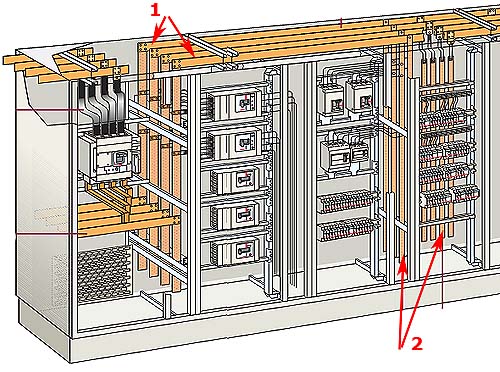
Рис. Legrand1 - Сборная шина
2 - Распределительные шины
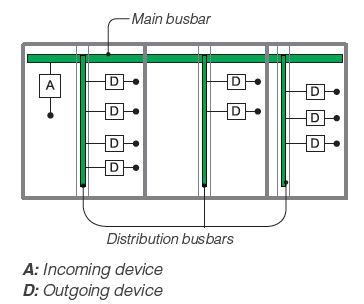
Рис. Schneider Electric:Main busbar - Сборная шина
Distribution busbars - Распределительные шины
A: Incoming device - А: Аппарат ввода
D: Outgoing device - D: Аппарат выводаТематики
- НКУ (шкафы, пульты,...)
EN
FR
система шин
Комплект элементов, связывающих между собой все присоединения электрического распределительного устройства.
[ ГОСТ 24291-90]EN
busbars (commonly called busbar)
in a substation, the busbar assembly necessary to make a common connection for several circuits
Example: three busbars for a three-phase system.
[IEV number 605-02-02]FR
jeu de barres (omnibus)
dans un poste, ensemble des barres omnibus nécessaires pour connecter des circuits
Exemple: trois barres pour un réseau triphasé.
[IEV number 605-02-02]Различают следующие системы:
-
одиночная система шин:
- одиночная несекционированная система шин;
- одиночная секционированная система шин;
-
двойная система шин
-
полуторная система шин
-
обходная система шин
- несекционированная система шин
-
секционированная система шин
- рабочая система шин
- резервная система шин
Тематики
- электротехника, основные понятия
Синонимы
EN
DE
FR
шина
Проводник с низким сопротивлением, к которому можно подсоединить несколько отдельных электрических цепей.
Примечание — Термин «шина» не включает в себя геометрическую форму, габариты или размеры проводника.
[ ГОСТ Р 51321. 1-2000 ( МЭК 60439-1-92)]
[ ГОСТ Р МЭК 61439.1-2013]
шина
Конструктивный элемент низковольтного комплектного устройства (НКУ).
Такой конструктивный элемент предназначен для того, чтобы к нему можно было легко присоединить отдельные электрические цепи (другие шины, отдельные проводники). Такие шины могут иметь различную конструкцию, геометрическую форму и размеры.
[Интент]
шинопроводшина
Медная, алюминиевая, реже стальная полоса, служащая для присоединения кабелей электрогенераторов, трансформаторов и т.д. к проводам питающей сети
[Терминологический словарь по строительству на 12 языках (ВНИИИС Госстроя СССР)]
общаяшина
-
[IEV number 151-12-30]
шина
-
[Я.Н.Лугинский, М.С.Фези-Жилинская, Ю.С.Кабиров. Англо-русский словарь по электротехнике и электроэнергетике, Москва]EN
busbar
low-impedance conductor to which several electric circuits can be connected at separate points
NOTE – In many cases, the busbar consists of a bar.
[IEV number 151-12-30]
busbar
An electrical conductor that makes a common connection between several circuits. Sometimes, electrical wire cannot accommodate high-current applications, and electricity must be conducted using a more substantial busbar — a thick bar of solid metal (usually copper or aluminum). Busbars are uninsulated, but are physically supported by insulators. They are used in electrical substations to connect incoming and outgoing transmission lines and transformers; in a power plant to connect the generator and the main transformers; in industry, to feed large amounts of electricity to equipment used in the aluminum smelting process, for example, or to distribute electricity in large buildings
[ABB. Glossary of technical terms. 2010]FR
barre omnibus, f
conducteur de faible impédance auquel peuvent être reliés plusieurs circuits électriques en des points séparés
NOTE – Dans de nombreux cas, une barre omnibus est constituée d’une barre.
[IEV number 151-12-30]
2. Проводник прямоугольного сечения из меди, предназначенный для электротехнических целей
(см. ГОСТ 434-78).
Поставляется в бухтах, а также в полосах длиной не менее 2,5 м; По существу, это просто проволока прямоугольного сечения. В указанном ГОСТе и в технической документации, в которой она применяется, обязательно указываются размеры этой проволоки. Например, "Шина ШММ 8,00х40,00 ГОСТ 434-78"
шина
Пруток прямоугольного сечения, применяемый в электротехнике в качестве проводника тока, изготовляемый прессованием или волочением.
[ ГОСТ 25501-82]Тематики
- НКУ (шкафы, пульты,...)
- заготовки и полуфабрикаты в металлургии
- кабели, провода...
Действия
- расположение шин «на ребро» [ПУЭ]
- расположение шин «плашмя» [ПУЭ]
Сопутствующие термины
- гибкая шина
- жесткая шина [ПУЭ]
- изолированные шины [ПУЭ]
- круглые шины [ПУЭ]
- неизолированные шины [ПУЭ]
- обходные шины [ПУЭ]
- профильные шины [ПУЭ]
- секционные шины [ПУЭ]
- фазная шина [ ГОСТ Р 51321.1-2000]
- четырехполосные шины с расположением полос по сторонам квадрата ("полый пакет") [ПУЭ]
- шина PEN-проводника
- шина для присоединения защитных проводников
- шина нулевого защитного проводника
- шина фазы А (B, C) [ПУЭ]
- шины однофазного тока [ПУЭ]
- шины прямоугольного (круглого, трубчатого, коробчатого) сечения [ПУЭ]
- шины трехфазного тока [ПУЭ]
EN
DE
FR
система сборных шин
шинопровод
Устройство, представляющее собой систему проводников, состоящее из шин, установленных на опорах из изоляционного материала или в каналах, коробах или подобных оболочках, и прошедшее типовые испытания.
Устройство может состоять из следующих элементов:
- прямые секции с узлами ответвления или без них;
- секции для изменения положения фаз, разветвления, поворота, а также вводные и переходные;
- секции ответвленные.
Примечание — Термин «шинопровод» не определяет геометрическую форму, габариты и размеры проводников.
(МЭС 441-12-07, с изменением)
[ ГОСТ Р 51321. 1-2000 ( МЭК 60439-1-92)]
шинопровод
Жесткий токопровод до 1 кВ заводского изготовления, поставляемый комплектными секциями.
[ПУЭ]
шинопровод
Жесткий токопровод напряжением до 1000 В заводского изготовления, поставляемый комплектными секциями.
[ОСТ 36-115-85]
шинопровод
Жесткий токопровод напряжением до 1 кВ, предназначенный для передачи и распределения электроэнергии, состоящий из неизолированных или изолированных проводников (шин) и относящихся к ним изоляторов, защитных оболочек, ответвительных устройств, поддерживающих и опорных конструкций.
[ ГОСТ Р 53310-2012]EN
busway
A prefabricated assembly of standard lengths of busbars rigidly supported by solid insulation and enclosed in a sheet-metal housing.
[ http://www.answers.com/topic/busway]
busway
Busway is defined by the National Electrical Manufacturers Association (NEMA) as a prefabricated electrical distribution system consisting of bus bars in a protective enclosure, including straight lengths, fittings, devices, and accessories. Busway includes bus bars, an insulating and/or support material, and a housing.
[ http://electrical-engineering-portal.com/siemens-busway-purpose-and-definition]1.1. Шинопроводы по назначению подразделяются на:
- распределительные, предназначенные для распределения электрической энергии;
- магистральные, предназначенные для передачи электрической энергии от источника к месту распределения (распределительным пунктам, распределительным шинопроводам) или мощным приемникам электрической энергии.
1.2. По конструктивному исполнению шинопроводы подразделяются на:
- трехфазные;
- трехфазные с нулевым рабочим проводником;
- трехфазные с нулевым рабочим и нулевым защитным проводником.
2. Основные параметры и размеры
2.1. Основные элементы шинопроводов
2.1.1. Основными элементами распределительных шинопроводов являются:а) прямые секции - для прямолинейных участков линии, имеющие места для присоединения одного или двух ответвительных устройств для секций длиной до 2 м включительно, двух, трех, четырех или более - для секций длиной 3 м;
б) прямые прогоночные секции - для прямолинейных участков линий, где присоединение ответвительных устройств не требуется;
в) угловые секции - для поворотов линии на 90° в горизонтальной и вертикальной плоскостях;
г) вводные секции или вводные коробки с коммутационной, защитной и коммутационной аппаратурой или без нее - для подвода питания к шинопроводам кабелем, проводами или шинопроводом;
д) переходные секции или устройства - для соединения двух шинопроводов на различные номинальные токи или шинопроводов разных конструкций;
е) ответвительные устройства (коробки, штепсели) - для разъемного присоединения приемников электрической энергии. Коробки должны выпускаться с разъединителем, с разъединителем и с предохранителями или с автоматическим выключателем;
з) присоединительные фланцы - для сочленения оболочек шинопроводов с оболочками щитов или шкафов;
и) торцовые крышки (заглушки) - для закрытия торцов крайних секций шинопровода;
к) устройства для крепления шинопроводов к элементам строительных конструкций зданий и сооружений;2.1.2. Основными элементами магистральных шинопроводов являются:
а) прямые секции - для прямолинейных участков линий;
б) угловые секции - для поворотов линий на 90° в горизонтальной и вертикальной плоскостях;
в) тройниковые секции - для разветвления в трех направлениях под углом 90° в горизонтальной и вертикальной плоскостях;
г) подгоночные секции - для подгонки линии шинопроводов до необходимой длины;
д) разделительные секции с разъединителем - для секционирования магистральных линий шинопроводов;
е) компенсационные секции - для компенсации температурных изменений длины линии шинопроводов;
ж) переходные секции - для соединения шинопроводов на разные номинальные токи;
з) ответвительные устройства (секции, коробки) - для неразборного, разборного или разъемного присоединения распределительных пунктов, распределительных шинопроводов или приемников электрической энергии. Коробки должны выпускаться с разъединителем, с разъединителем и предохранителями или с автоматическим выключателем; секции могут выпускаться без указанных аппаратов;
и) присоединительные секции - для присоединения шинопроводов к комплектным трансформаторным подстанциям;
к) проходные секции - для прохода через стены и перекрытия;
л) набор деталей и материалов для изолирования мест соединения секций шинопроводов с изолированными шинами;
м) устройства для крепления шинопроводов к элементам строительных конструкций зданий и сооружений;
н) крышки (заглушки) торцовые и угловые для закрытия торцов концевых секций шинопровода и углов.
2.2.3. В зависимости от вида проводников токопроводы подразделяются на гибкие (при использовании проводов) и жесткие (при использовании жестких шин).
Жесткий токопровод до 1 кВ заводского изготовления, поставляемый комплектными секциями, называется шинопроводом.
В зависимости от назначения шинопроводы подразделяются на:- магистральные, предназначенные в основном для присоединения к ним распределительных шинопроводов и силовых распределительных пунктов, щитов и отдельных мощных электроприемников;
- распределительные, предназначенные в основном для присоединения к ним электроприемников;
- троллейные, предназначенные для питания передвижных электроприемников;
- осветительные, предназначенные для питания светильников и электроприемников небольшой мощности.
[ПУЭ, часть 2]
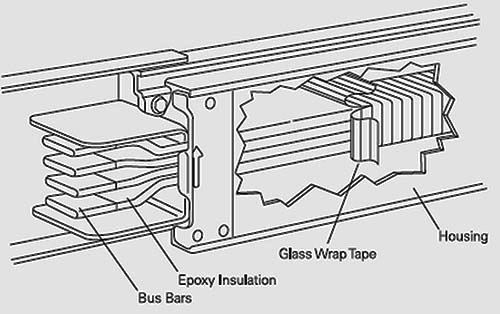
[ http://electrical-engineering-portal.com/siemens-busway-purpose-and-definition]
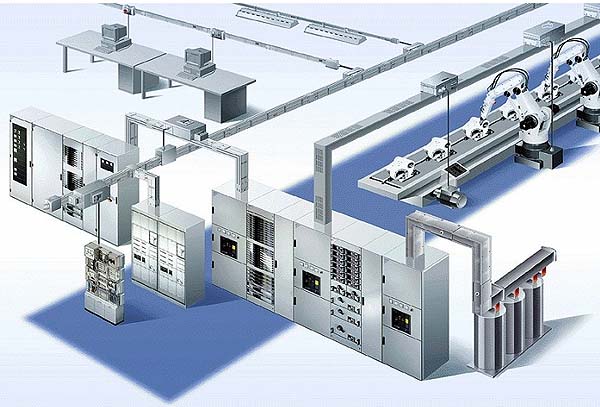
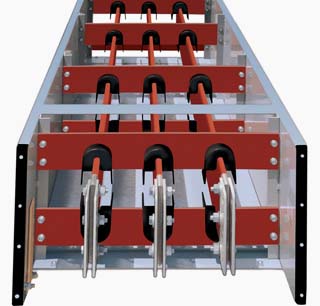
[ http://electrical-engineering-portal.com/standards-and-applications-of-medium-voltage-bus-duct]
Конструкция шинопровода на среднее напряжениеПараллельные тексты EN-RU
A major advantage of busway is the ease in which busway sections are connected together.
Electrical power can be supplied to any area of a building by connecting standard lengths of busway.
It typically takes fewer man-hours to install or change a busway system than cable and conduit assemblies.Основное преимущество шинопровода заключается в легкости соединения его секций.
Соединяя эти стандартные секции можно легко снабдить электроэнергией любую часть здания.
Как правило, установить или изменить систему шинопроводов занимает гораздо меньше времени, чем выполнить аналогичные работы, применяя разводку кабелем в защитных трубах.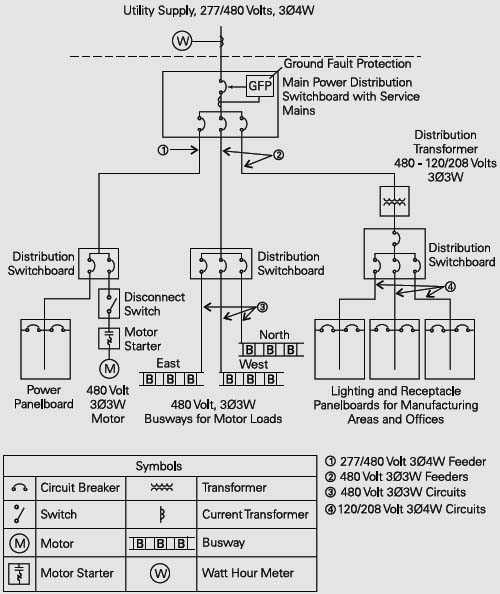
[ http://electrical-engineering-portal.com/siemens-busway-purpose-and-definition]
The total distribution system frequently consists of a combination of busway and cable and conduit.
In this example power from the utility company is metered and enters the plant through a distribution switchboard.
The switchboard serves as the main disconnecting means.Как правило, распределение электроэнергии производится как через шинопроводы, так и через проложенные в защитных трубах кабели.
В данном примере поступающая от питающей сети электроэнергия измеряется на вводе в главное распределительный щит (ГРЩ).
ГРЩ является главным коммутационным устройством.
The feeder on the left feeds a distribution switchboard, which in turn feeds a panelboard and a 480 volt, three-phase, three-wire (3Ø3W) motor.
Распределительная цепь, изображенная слева, питает распределительный щит, который в свою очередь питает групповой щиток и электродвигатель.
Электродвигатель получает питание через трехфазную трехпроводную линию напряжением 480 В.The middle feeder feeds another switchboard, which divides the power into three, three-phase, three-wire circuits. Each circuit feeds a busway run to 480 volt motors.
Средняя (на чертеже) распределительная цепь питает другой распределительный щит, от которого электроэнергия распределяется через три трехфазные трехпроводные линии на шинопроводы.
Каждый шинопровод используется для питания электродвигателей напряжением 480 В.The feeder on the right supplies 120/208 volt power, through a step-down transformer, to lighting and receptacle panelboards.
Распределительная цепь, изображенная справа, питает напряжением 120/208 В через понижающий трансформатор щитки для отдельных групп светильников и штепсельных розеток.
Branch circuits from the lighting and receptacle panelboards supply power for lighting and outlets throughout the plant.
[ http://electrical-engineering-portal.com/siemens-busway-purpose-and-definition]Групповые электрические цепи, идущие от групповых щитков, предназначены для питания всех светильников и штепсельных розеток предприятия.
[Перевод Интент]Selection of the busbar trunking system based on voltage drop.
[Legrand]Выбор шинопровода по падению напряжения.
[Перевод Интент]
Недопустимые, нерекомендуемые
Примечание(1)- Мнение автора карточкиТематики
- изделие электромонтажное
- электропроводка, электромонтаж
Обобщающие термины
Близкие понятия
- электропроводки, выполненные шинопроводами
Действия
- выбор шинопровода по...
- крепление шинопровода к опорным конструкциям
- монтаж шинопроводов
- применение шинопроводов в пожароопасных зонах
- проектирование шинопровода
- прокладка шинопровода
Сопутствующие термины
- вертикальный участок шинопровода
- горизонтальный участок шинопровода
- прямой участок шинопровода
- устройства для крепления шинопроводов
- шинопровод переменного тока на 1600 А
- электрическая сеть, выполняемая шинопроводами
EN
DE
FR
3.1.31 сборная шина (busbar): Проводник с низким сопротивлением, к которому могут быть подсоединены несколько различных электрических цепей.
Источник: ГОСТ Р 54828-2011: Комплектные распределительные устройства в металлической оболочке с элегазовой изоляцией (КРУЭ) на номинальные напряжения 110 кВ и выше. Общие технические условия оригинал документа
Англо-русский словарь нормативно-технической терминологии > busbar
-
18 method
1) метод; приём; способ2) методика3) технология4) система•- accelerated strength testing method-
benching method-
bullhead well control method-
electrical-surveying method-
electromagnetic surveying method-
long-wire transmitter method-
operational method-
rule of thumb method-
straight flange method of rolling beams-
symbolical method-
tee-test method-
testing method-
triangulation method-
value-iteration method -
19 laser
лазер || лазерный- laser with dynamic liquid crystal mirrors
- acidic umbelliferone laser
- acoustooptically-tuned laser
- acquisition laser
- active infrared detection laser
- actively mode-locked laser
- actively Q-switched laser
- alignment laser
- alkali-halide laser
- alpha-particle laser
- amorphous laser
- amplitude stabilized laser
- anisotropic laser
- anorganic vapor laser
- antisubmarine laser
- Ar laser
- arc-driven laser
- arc-excited laser
- argon laser
- atmospheric pressure laser
- atomic laser
- atomic-beam laser
- Au vapor laser
- avalanche injection laser
- axially excited laser
- beam-expanded laser
- BH injection laser
- bidirectional laser
- bistable laser
- black-body laser
- black-body pumped laser
- blue laser
- Bragg laser
- Brewster-angled laser
- bromine vapor laser
- Br vapor laser
- bulk ionized laser
- buried-heterostructure injection laser
- butt-coupled laser
- C-laser
- Ca laser
- cadmium selenide laser
- cadmium sulfide laser
- cadmium vapor laser
- calcium vapor laser
- carbazine laser
- carbon dioxide laser
- carbon monoxide laser
- carbon vapor laser
- carbopyronine laser
- cascade laser
- cataphoresis pumping laser
- cavity laser
- Cd laser
- ceramic laser
- chain-reaction laser
- chelate laser
- chemical laser
- chemically excited laser
- chemically pumped laser
- chemical transfer laser
- chirped laser
- chlorine laser
- circular ring laser
- circulated-liquid laser
- Cl laser
- close-confinement laser
- closed-cycle laser
- CO laser
- CO2 laser
- coaxial laser
- coaxial-flow laser
- color-center laser
- combustion laser
- combustion powered laser
- composite-rod laser
- Compton laser
- condensed-phase laser
- confined-phase laser
- confocal laser
- CO2+N2+He laser
- continuously operated ruby laser
- continuously pumped laser
- continuously running laser
- continuous-wave laser
- convectively-cooled laser
- copper iodide laser
- copper vapor laser
- corner-cube laser
- coumarin laser
- coupled-cavity laser
- cross-beam laser
- cross-discharge laser
- cross-field laser
- cross-pumped laser
- cryogenic laser
- crystalline laser
- Cu laser
- CW laser
- dc-excited laser
- deflection laser
- deuterium fluoride laser
- DFB laser
- dielectric gas laser
- dielectric solid-state laser
- diffraction-limited laser
- diffraction-stabilized laser
- diffused laser
- diffusion-cooled laser
- dimer laser
- diode laser
- diode-pumped laser
- direct-gap injection laser
- directly modulated laser
- disk laser
- distributed laser
- distributed-feedback laser
- double-beam laser
- double-discharge laser
- double-frequency laser
- double-heterojunction laser
- double-heterostructure laser
- double-injection laser
- double-mode laser
- double-pulse laser
- double-quantum laser
- doubly mode-locked laser
- dual laser
- dye laser
- dye-doped polymethylmethacrylate laser
- E-beam-controlled laser
- E-beam-pumped laser
- electrically excited laser
- electric-discharge laser
- electroionization laser
- electron-beam laser
- electron-beam-excited laser
- electron-beam-initiated laser
- electron-beam plasma laser
- electron-beam-pumped laser
- electron-beam-stabilized laser
- electron-beam-triggering laser
- electron-collisionally excited ionic laser
- electronic transition laser
- electronic-vibrational transition laser
- electrooptically tuned laser
- ELION laser
- end-pumped laser
- epitaxial laser
- epitaxial-grown laser
- equilateral triangular laser
- erasing laser
- erbium-glass laser
- evanescent-field-pumped laser
- evanescent-wave-pumped laser
- excimer laser
- excited-state dimer laser
- exciting laser
- exciton laser
- explosion laser
- explosively pumped laser
- externally excited laser
- external-mirror laser
- extrinsically tuned laser
- face-pumped laser
- far-infrared laser
- far-ultraviolet laser
- fast-flowing laser
- feedback laser
- fiber laser
- fiber-tailed laser
- fixed-frequency laser
- flame laser
- flashlamp-pumped laser
- flowing gas laser
- flowing molecular laser
- four-level laser
- free-electron laser
- free-running laser
- frequency-controlled laser
- frequency-doubled laser
- frequency-modulated laser
- frequency-multiplied laser
- frequency-tuned laser
- fundamental-mode laser
- Ga-As laser
- gain-guided laser
- gain-switched laser - gamma-ray laser
- gas laser
- gas-discharge laser - gold vapor laser
- grating-controlled laser
- grating-coupled laser
- green laser
- green argon laser
- HCI vibrational-rotational laser
- heat-pumped laser
- heavy doped laser
- helium-iodine laser
- helium-krypton laser
- helium-xenon laser
- He-Ne laser
- heterojunction laser
- heterostructure laser
- heterostructure injection laser
- Hg laser
- high-current ion laser
- high-energy laser
- high-gain laser
- high-intensity laser
- highly coherent laser
- high-power laser
- high-pressure laser
- high-repetition-rate laser
- hollow-cathode laser
- holmium glass laser
- homogeneously broadened laser
- homogeneously pumped laser
- homojunction laser
- homostructure laser
- hybrid laser
- hydrogen laser
- hydrogen halide laser
- I-laser
- illuminating laser
- incoherently pumped laser
- index-guided laser
- indirect-gap injection laser - inhomogeneously pumped laser
- initiated laser
- initiating laser
- injection laser
- injection-locking laser
- injection-plasma laser
- inorganic-liquid laser
- integral compact glass laser
- internal-mirror laser
- intracavity modulated laser
- iodine laser
- ion laser
- ionization-assisted gas laser
- ionized laser
- IR laser
- Javan's laser
- junction laser
- Kerr-cell switched laser
- Kr laser
- krypton laser
- Lamb-dip stabilized laser
- large-aperture laser
- large-optical-cavity laser
- laser-pumped laser
- layered laser
- lead selenide laser
- lead sulfide laser
- lead telluride laser
- lead tin telluride laser
- lead vapor laser
- light-emitting-diode pumped laser
- light-pumped laser
- liquid laser
- liquid-dye laser
- LOC laser
- longitudinal-flow laser
- longitudinal-pumped laser
- long-wavelength laser
- low-power laser
- low-pressure laser
- low-threshold laser
- magnetically confined ion gas laser
- magnetohydrodynamic laser
- magnetooptical laser
- manganese vapor laser
- many-element laser
- mass-transport buried heterostructure laser
- master laser
- mercury vapor laser
- mesa laser
- metal vapor laser
- MHD laser
- microwave-pumped laser
- millimeter laser
- millimeter-wave laser
- mirror-angle tuned laser
- mirrorless laser
- Mn vapor laser
- mode-controlled laser
- mode-coupled laser
- mode-limited laser
- mode-locked laser
- mode-selected laser
- molecular laser
- molecular nitrogen discharge laser
- MTBH laser
- multicolor laser
- multifrequency laser
- multiline laser
- multilongitudinal-mode laser
- multimodal laser
- multimode laser
- multiphoton laser
- multiple-dye laser
- multiple-pulse laser
- multiple quantum-well laser
- multiple-wavelength laser
- multiprism laser
- mutually pumped injection laser
- Nd-doped yttrium-aluminum-garnet laser
- Nd-glass laser
- Nd-YAG laser
- Ne laser
- near-IR laser
- neodymium-doped phosphorous chloride laser
- neodymium glass laser
- neodymium liquid laser
- neodymium-selenium oxychloride laser
- neodymium-ytterbium glass laser
- neodymium-yttrium-erbium glass laser
- neon laser
- neutral gas laser
- nitrogen laser
- nitrogen-carbon dioxide laser
- noble-gas laser
- noncavity laser
- nonmode-selected laser
- nonspiking laser
- nuclear laser
- nuclear-charged self-sustaining laser
- nuclear-pumped laser
- nuclear γ-laser
- O-laser
- optical-avalanche laser
- optical fiber laser
- optically pumped laser
- organic laser
- organic-dye laser
- overtone laser
- oxazine laser
- oxygen laser
- P-laser
- parallel-plate laser
- passively mode-locked laser
- passively Q-switched laser
- Pb ion laser
- phase-conjugate -laser
- phase-locked laser
- phosphorous vapor laser
- photochemical laser
- photodissociation laser
- photoexcitation laser
- photoinitiated laser
- photoionization laser
- photoionized laser
- photorecombination laser
- pigtailed laser
- pinched-plasma laser
- pink-ruby laser
- planar stripe laser
- plane-resonator laser
- plasma laser
- p-n laser
- p-n junction laser
- polycrystalline laser
- positive-column-discharge laser
- potassium bromide laser
- p-p-n-n laser
- preionization laser
- preionized laser
- premixed chemical laser
- pressure-tuned laser
- prism dye laser
- prism-tuned laser
- PS laser
- pulsed laser
- pulsed electrical laser
- pulsed ruby laser
- pulsed water-vapor laser
- pulse-initiated chemical laser
- pumped laser
- pumping laser
- pyrotechnically pumped laser
- Q-spoiled laser
- Q-switched laser
- Q-switching laser
- quantum-well laser
- quartz laser
- quasi-continuous laser
- radial-discharge laser
- Raman laser
- rare-earth chelate laser
- rare-gas electrical-discharge laser
- reading laser
- recombination laser
- red laser
- regularly pulsing laser
- repetitively pumped laser
- resonanit laser
- RF excited laser
- rhodamine laser
- rhodamine 6G-laser
- Ridley-Watkins-Hillsum-mechanism laser
- ring laser
- roof-top ruby laser
- rotation laser
- ruby laser
- RWH-mechanism laser
- S-laser
- scan laser
- SCH laser
- sealed-off laser
- selenium vapor laser
- self-contained laser
- self-focusing laser
- self-locked laser
- self-mode-locking laser
- self-Q-switching laser
- self-starting laser
- self-sustained laser
- self-terminating laser
- self-tuned laser
- semiconductor laser
- separate-confinement heterostructure laser
- shock-tube laser
- shock-wave pumped laser
- short-pulsed laser
- Si laser
- silicon vapor laser
- single-frequency laser
- single-heterojunction laser
- single-heterostructure laser
- single-longitudinal-mode laser
- single-mode laser
- single-mode pumped laser
- single-shot pumped laser
- single-wavelength laser
- slave laser
- SLM laser
- slotted cathode laser
- slow-flowing laser
- software laser
- solar-pumped laser
- solid laser
- solid-dye laser
- solid rare-earth ion laser
- solid-state laser
- spikeless laser
- spiking laser
- spin-flip laser
- Sr laser
- storage laser
- storage-ring laser
- streamer laser
- stripe laser
- stripe-geometry laser
- strontium vapor laser
- submillimeter laser
- subsonic-flow laser
- sulfur-hexafluoride laser
- sulfur-vapor laser
- sun-pumped laser
- superlattice laser
- superluminescent laser
- superpower laser
- superradiant laser
- superradiative laser
- supersonic laser
- synchronously-pumped laser
- TEA laser
- telescopic-resonator laser
- temperature-controlled laser
- thallium vapor laser
- thermally controlled laser
- thermally excited laser
- thermally pumped laser
- thick-cavity junction laser
- thin-film laser
- thin-film diode laser
- three-level laser
- tin vapor laser
- tracking laser
- transfer chemical laser
- transverse electrically initiated laser
- transverse-excitation atmospheric laser
- transverse-excitation atmospheric pressure laser
- transverse-flow laser
- transverse-flow mixing laser
- traveling-wave laser
- triode laser
- tunable laser
- tunable diode laser
- tunnel laser
- tunnel-injection laser
- two-frequency laser
- two-isotope active medium laser
- two-photon pumped laser
- ultraviolet laser
- uncontrolled laser
- unidirectional laser
- unimodal laser
- unstable-resonator laser
- UV laser
- vacuum-ultraviolet laser
- variable pulse-length laser
- variable-wavelength laser
- vernier interferometric laser
- vibrational-rotation laser
- vibrational-transition laser
- visible laser
- VUV laser
- waveguide laser
- waveguide-pumping laser
- writing laser
- Xe laser
- xenon ion laser
- X-ray laser
- ytterbium glass laser
- Zeeman laser
- zero-order-mode laser
- zinc oxide laser
- zinc-oxide nanowire laser
- zinc sulfide laser
- zinc vapor laser
- Zn laser -
20 laser
лазер || лазерный- acoustooptically-tuned laser
- acquisition laser
- active infrared detection laser
- actively mode-locked laser
- actively Q-switched laser
- alignment laser
- alkali-halide laser
- alpha-particle laser
- amorphous laser
- amplitude stabilized laser
- anisotropic laser
- anorganic vapor laser
- antisubmarine laser
- Ar laser
- arc-driven laser
- arc-excited laser
- argon laser
- atmospheric pressure laser
- atomic laser
- atomic-beam laser
- Au vapor laser
- avalanche injection laser
- axially excited laser
- beam-expanded laser
- BH injection laser
- bidirectional laser
- bistable laser
- black-body laser
- black-body pumped laser
- blue laser
- Br vapor laser
- Bragg laser
- Brewster-angled laser
- bromine vapor laser
- bulk ionized laser
- buried-heterostructure injection laser
- butt-coupled laser
- C laser
- Ca laser
- cadmium selenide laser
- cadmium sulfide laser
- cadmium vapor laser
- calcium vapor laser
- carbazine laser
- carbon dioxide laser
- carbon monoxide laser
- carbon vapor laser
- carbopyronine laser
- cascade laser
- cataphoresis pumping laser
- cavity laser
- Cd laser
- ceramic laser
- chain-reaction laser
- chelate laser
- chemical laser
- chemical transfer laser
- chemically excited laser
- chemically pumped laser
- chirped laser
- chlorine laser
- circular ring laser
- circulated-liquid laser
- Cl laser
- close-confinement laser
- closed-cycle laser
- CO laser
- CO2 + N2 + He laser
- CO2 laser
- coaxial laser
- coaxial-flow laser
- color-center laser
- combustion laser
- combustion powered laser
- composite-rod laser
- Compton laser
- condensed-phase laser
- confined-phase laser
- confocal laser
- continuously operated ruby laser
- continuously pumped laser
- continuously running laser
- continuous-wave laser
- convectively-cooled laser
- copper iodide laser
- copper vapor laser
- corner-cube laser
- coumarin laser
- coupled-cavity laser
- cross-beam laser
- cross-discharge laser
- cross-field laser
- cross-pumped laser
- cryogenic laser
- crystalline laser
- Cu laser
- CW laser
- dc-excited laser
- deflection laser
- deuterium fluoride laser
- DFB laser
- dielectric gas laser
- dielectric solid-state laser
- diffraction-limited laser
- diffraction-stabilized laser
- diffused laser
- diffusion-cooled laser
- dimer laser
- diode laser
- diode-pumped laser
- direct-gap injection laser
- directly modulated laser
- disk laser
- distributed laser
- distributed-feedback laser
- double-beam laser
- double-discharge laser
- double-frequency laser
- double-heterojunction laser
- double-heterostructure laser
- double-injection laser
- double-mode laser
- double-pulse laser
- double-quantum laser
- doubly mode-locked laser
- dual laser
- dye laser
- dye-doped polymethylmethacrylate laser
- E-beam-controlled laser
- E-beam-pumped laser
- electrically excited laser
- electric-discharge laser
- electroionization laser
- electron-beam laser
- electron-beam plasma laser
- electron-beam-excited laser
- electron-beam-initiated laser
- electron-beam-pumped laser
- electron-beam-stabilized laser
- electron-beam-triggering laser
- electron-collisionally excited ionic laser
- electronic transition laser
- electronic-vibrational transition laser
- electrooptically tuned laser
- ELION laser
- end-pumped laser
- epitaxial laser
- epitaxial-grown laser
- equilateral triangular laser
- erasing laser
- erbium-glass laser
- evanescent-field-pumped laser
- evanescent-wave-pumped laser
- excimer laser
- excited-state dimer laser
- exciting laser
- exciton laser
- explosion laser
- explosively pumped laser
- externally excited laser
- external-mirror laser
- extrinsically tuned laser
- face-pumped laser
- far-infrared laser
- far-ultraviolet laser
- fast-flowing laser
- feedback laser
- fiber laser
- fiber-tailed laser
- fixed-frequency laser
- flame laser
- flashlamp-pumped laser
- flowing gas laser
- flowing molecular laser
- four-level laser
- free-electron laser
- free-running laser
- frequency-controlled laser
- frequency-doubled laser
- frequency-modulated laser
- frequency-multiplied laser
- frequency-tuned laser
- fundamental-mode laser
- Ga-As laser
- gain-guided laser
- gain-switched laser
- gallium arsenide laser
- gallium nitride laser
- gamma-ray laser
- gas laser
- gas-discharge laser
- gas-dynamic laser
- giant-pulse laser
- giant-pulse ruby laser
- glass laser
- gold vapor laser
- grating-controlled laser
- grating-coupled laser
- green argon laser
- green laser
- HCI vibrational-rotational laser
- heat-pumped laser
- heavy doped laser
- helium-iodine laser
- helium-krypton laser
- helium-xenon laser
- He-Ne laser
- heterojunction laser
- heterostructure injection laser
- heterostructure laser
- Hg laser
- high-current ion laser
- high-energy laser
- high-gain laser
- high-intensity laser
- highly coherent laser
- high-power laser
- high-pressure laser
- high-repetition-rate laser
- hollow-cathode laser
- holmium glass laser
- homogeneously broadened laser
- homogeneously pumped laser
- homojunction laser
- homostructure laser
- hybrid laser
- hydrogen halide laser
- hydrogen laser
- I laser
- illuminating laser
- incoherently pumped laser
- index-guided laser
- indirect-gap injection laser
- infrared laser
- inhomogeneously broadened laser
- inhomogeneously pumped laser
- initiated laser
- initiating laser
- injection laser
- injection-locking laser
- injection-plasma laser
- inorganic-liquid laser
- integral compact glass laser
- internal-mirror laser
- intracavity modulated laser
- iodine laser
- ion laser
- ionization-assisted gas laser
- ionized laser
- IR laser
- Javan's laser
- junction laser
- Kerr-cell switched laser
- Kr laser
- krypton laser
- Lamb-dip stabilized laser
- large-aperture laser
- large-optical-cavity laser
- laser on supersonic jet
- laser with dynamic liquid crystal mirrors
- laser-pumped laser
- layered laser
- lead selenide laser
- lead sulfide laser
- lead telluride laser
- lead tin telluride laser
- lead vapor laser
- light-emitting-diode pumped laser
- light-pumped laser
- liquid laser
- liquid-dye laser
- LOC laser
- longitudinal-flow laser
- longitudinal-pumped laser
- long-wavelength laser
- low-power laser
- low-pressure laser
- low-threshold laser
- magnetically confined ion gas laser
- magnetohydrodynamic laser
- magnetooptical laser
- manganese vapor laser
- many-element laser
- mass-transport buried heterostructure laser
- master laser
- mercury vapor laser
- mesa laser
- metal vapor laser
- MHD laser
- microwave-pumped laser
- millimeter laser
- millimeter-wave laser
- mirror-angle tuned laser
- mirrorless laser
- Mn vapor laser
- mode-controlled laser
- mode-coupled laser
- mode-limited laser
- mode-locked laser
- mode-selected laser
- molecular laser
- molecular nitrogen discharge laser
- MTBH laser
- multicolor laser
- multifrequency laser
- multiline laser
- multilongitudinal-mode laser
- multimodal laser
- multimode laser
- multiphoton laser
- multiple quantum-well laser
- multiple-dye laser
- multiple-pulse laser
- multiple-wavelength laser
- multiprism laser
- mutually pumped injection laser
- Nd-doped yttrium-aluminum-garnet laser
- Nd-glass laser
- Nd-YAG laser
- Ne laser
- near-IR laser
- neodymium glass laser
- neodymium liquid laser
- neodymium-doped phosphorous chloride laser
- neodymium-selenium oxychloride laser
- neodymium-ytterbium glass laser
- neodymium-yttrium-erbium glass laser
- neon laser
- neutral gas laser
- nitrogen laser
- nitrogen-carbon dioxide laser
- noble-gas laser
- noncavity laser
- nonmode-selected laser
- nonspiking laser
- nuclear γ laser
- nuclear laser
- nuclear-charged self-sustaining laser
- nuclear-pumped laser
- O laser
- optical fiber laser
- optical-avalanche laser
- optically pumped laser
- organic laser
- organic-dye laser
- overtone laser
- oxazine laser
- oxygen laser
- P laser
- parallel-plate laser
- passively mode-locked laser
- passively Q-switched laser
- Pb ion laser
- phase-conjugate-laser
- phase-locked-laser
- phosphorous vapor laser
- photochemical laser
- photodissociation laser
- photoexcitation laser
- photoinitiated laser
- photoionization laser
- photoionized laser
- photorecombination laser
- pigtailed laser
- pinched-plasma laser
- pink-ruby laser
- planar stripe laser
- plane-resonator laser
- plasma laser
- p-n junction laser
- p-n laser
- polycrystalline laser
- positive-column-discharge laser
- potassium bromide laser
- p-p-n-n laser
- preionization laser
- preionized laser
- premixed chemical laser
- pressure-tuned laser
- prism dye laser
- prism-tuned laser
- PS laser
- pulsed electrical laser
- pulsed laser
- pulsed ruby laser
- pulsed water-vapor laser
- pulse-initiated chemical laser
- pumped laser
- pumping laser
- pyrotechnically pumped laser
- Q-spoiled laser
- Q-switched laser
- Q-switching laser
- quantum-well laser
- quartz laser
- quasi-continuous laser
- radial-discharge laser
- Raman laser
- rare-earth chelate laser
- rare-gas electrical-discharge laser
- reading laser
- recombination laser
- red laser
- regularly pulsing laser
- repetitively pumped laser
- resonanit laser
- RF excited laser
- rhodamine 6G laser
- rhodamine laser
- Ridley-Watkins-Hillsum-mechanism laser
- ring laser
- roof-top ruby laser
- rotation laser
- ruby laser
- RWH-mechanism laser
- S laser
- scan laser
- SCH laser
- sealed-off laser
- selenium vapor laser
- self-contained laser
- self-focusing laser
- self-locked laser
- self-mode-locking laser
- self-Q-switching laser
- self-starting laser
- self-sustained laser
- self-terminating laser
- self-tuned laser
- semiconductor laser
- separate-confinement heterostructure laser
- shock-tube laser
- shock-wave pumped laser
- short-pulsed laser
- Si laser
- silicon vapor laser
- single-frequency laser
- single-heterojunction laser
- single-heterostructure laser
- single-longitudinal-mode laser
- single-mode laser
- single-mode pumped laser
- single-shot pumped laser
- single-wavelength laser
- slave laser
- SLM laser
- slotted cathode laser
- slow-flowing laser
- software laser
- solar-pumped laser
- solid laser
- solid rare-earth ion laser
- solid-dye laser
- solid-state laser
- spikeless laser
- spiking laser
- spin-flip laser
- Sr laser
- storage laser
- storage-ring laser
- streamer laser
- stripe laser
- stripe-geometry laser
- strontium vapor laser
- submillimeter laser
- subsonic-flow laser
- sulfur-hexafluoride laser
- sulfur-vapor laser
- sun-pumped laser
- superlattice laser
- superluminescent laser
- superpower laser
- superradiant laser
- superradiative laser
- supersonic laser
- synchronously-pumped laser
- TEA laser
- telescopic-resonator laser
- temperature-controlled laser
- thallium vapor laser
- thermally controlled laser
- thermally excited laser
- thermally pumped laser
- thick-cavity junction laser
- thin-film diode laser
- thin-film laser
- three-level laser
- tin vapor laser
- tracking laser
- transfer chemical laser
- transverse electrically initiated laser
- transverse-excitation atmospheric laser
- transverse-excitation atmospheric pressure laser
- transverse-flow laser
- transverse-flow mixing laser
- traveling-wave laser
- triode laser
- tunable diode laser
- tunable laser
- tunnel laser
- tunnel-injection laser
- two-frequency laser
- two-isotope active medium laser
- two-photon pumped laser
- ultraviolet laser
- uncontrolled laser
- unidirectional laser
- unimodal laser
- unstable-resonator laser
- UV laser
- vacuum-ultraviolet laser
- variable pulse-length laser
- variable-wavelength laser
- vernier interferometric laser
- vibrational-rotation laser
- vibrational-transition laser
- visible laser
- VUV laser
- waveguide laser
- waveguide-pumping laser
- writing laser
- Xe laser
- xenon ion laser
- X-ray laser
- ytterbium glass laser
- Zeeman laser
- zero-order-mode laser
- zinc oxide laser
- zinc sulfide laser
- zinc vapor laser
- zinc-oxide nanowire laser
- Zn laserThe New English-Russian Dictionary of Radio-electronics > laser
См. также в других словарях:
Copper wire and cable — Copper has been used in electric wiring since the invention of the electromagnet and the telegraph in the 1820s.[1][2] The invention of the telephone in 1876 proved to be another early boon for copper wire.[3] Today, despite competition from… … Wikipedia
Electrical wiring — in general refers to insulated conductors used to carry electricity, and associated devices. This article describes general aspects of electrical wiring as used to provide power in buildings and structures, commonly referred to as building wiring … Wikipedia
Copper loss — is the term often given to heat produced by electrical currents in the conductors of transformer windings, or other electrical devices. Copper losses are an undesirable transfer of energy, as are core losses, which result from induced currents in … Wikipedia
Copper-based chips — are semiconductor integrated circuits, usually microprocessors, which use copper for interconnections. Since copper is a better conductor than aluminium, chips using this technology can have smaller metal components, and use less energy to pass… … Wikipedia
Copper sheathing — was the practice of protecting the under water hull of a ship or boat through the use of copper plates affixed to the outside of the hull. It was pioneered and developed by the Royal Navy during the 18th century. Contents 1 Development 2 Humphry… … Wikipedia
Copper interconnect — Copper based chips are semiconductor integrated circuits, usually microprocessors, which use copper for interconnections. Since copper is a better conductor than aluminium, chips using this technology can have smaller metal components, and use… … Wikipedia
Copper alloys — are alloys with copper as their principal component. They have high resistance to corrosion.Due to its high electric conductivity, pure electrolytic copper is used mostly for making of electrical cables. Compositions The similarity in external… … Wikipedia
Copper pour — on a printed circuit board flowing around tracks and pads … Wikipedia
Copper indium gallium selenide solar cells — Copper indium gallium selenide (CuIn1 xGaxSe2 or CIGS) is a direct bandgap semiconductor useful for the manufacture of solar cells. Because the material strongly absorbs sunlight, a much thinner film is required than of other semiconductor… … Wikipedia
Electrical conduit — risers, seen inside fire resistance rated shaft, as seen entering bottom of a firestop. The firestop is made of firestop mortar on top, rockwool on the bottom. Raceways are used to protect cables from damage … Wikipedia
Copper coulometer — The copper coulometer is a one of the common application of the copper copper(II) sulfate electrode. Such a coulometer consists of two identical copper electrodes immersed in slightly acidic pH buffered solution of copper(II) sulfate. Passing of… … Wikipedia
